Who’s the “Unidentified Woman?” (Part Three)

This summer, a mystery book like no other—a story of rape, revenge, and redemption—will be published online, available throughout the E-reader Universe (see a short description of the novel by clicking on the “Woman” page above). Be the first to read an excerpt, and have an initial clue on the road to solving the mystery: who is she, the Unidentified Woman, and what’s her story? Here’s a short excerpt:

It is more than a year now since he brought me here to Los Angeles. To a place called Whittier. I see no nice people and no big cars. I see none of what Big Mamá told me I would find here in America. All I find here are poor and miserable people like me. Like me they work all day in the sweatshop. I hate it but what can I do? Mario beats me up when I refuse to go. I get no money from him. I’m still paying him my way here to El Norte, he says. For all his troubles and expenses. As if I asked him to bring me here.

I speak no English. Of course I don’t—I don’t speak at all. I can’t yet. Don’t know why, Adela. Maybe if I ever meet you again I will start speaking again. I see no television and read no papers or books. I don’t go to the movies. I don’t have any friends. I live with him in this little upstairs apartment. I cook for him, too, then serve him in bed.

I serve his friends also, and gringos he brings sometimes with other girls like me: from South America and from Asia, all of them. That’s much I know. I’m not stupid, even if everybody thinks I am. Let them think so. I’m helpless, maybe, but I’m not dead yet.

Leave a Comment

Filed under Literary

Who’s the “Unidentified Woman?”

This summer, a Beach Book like no other—a story of rape, revenge, and redemption—will be published online, available throughout the Global E-reader Universe (see a short description of the novel by clicking the “WOMAN” page above). Be the first to read an excerpt, and have an initial clue on the road to solving the mystery: who is she, the Unidentified Woman, and what’s her story?      This is Post Two, with a short excerpt:

At the farm, the next day

We arrive at the farm the next morning. I don’t know where we are. All I know is, we drove almost the whole night. They stopped to eat and then slept in the car for maybe an hour or two. I didn’t eat or sleep at all. The man who grabbed me and held me also touched me in my private part. Nobody ever did that to me before. His fat finger went in there and hurt me so bad. They were laughing about it later but I kept crying. 

I’m crying now, too, when he gets out of the car and pulls me out with him. We’re inside this farmhouse, so I can’t see what the outside of it looks like. I don’t want to see it—I want to go back home to my Mami. I promised her in the morning, before leaving the house to school, that I won’t be late. More than anything else in this world I now want to help her in the kitchen and learn how to sew. But how can I explain to her why I’m so late? How can I tell her what this man did to me in the car? She would never believe me, I know her. It’s better for me to die right now.

“We found another girl for you, Big Mamá,” the man who drove the car tells a big fat woman who comes out of the house. She wears baggy pants and sloppy, thick shirt over her mountain belly. Not even a skirt or a dress like the women in my village wear.

“She’s not damaged,” says the ugly man who grabbed me and held me all night, when he hands me over to her. “But she keeps crying all the time like a baby.”

“I want to go home to my Mami,” I say, trying to control my cry.

These are the first words I say since they took me away from my home village. I think, maybe because she is a woman and a Big Mamá, she will understand and send me back home. But her arm, the way she holds me, is even stronger and more hurting than how the man held me.

“I’m your Mami now,” she tells me with a threatening voice, “so stop crying!”

I cry even louder when I hear her saying that. She is not my Mami. She is…

She slaps me. So hard that I see only dark skies and I lose my balance. I fall—but not on the ground. I’m falling and falling into an empty space. I’m going to die. Dios mio: please let me die.

Leave a Comment

Filed under Literary

Who’s the “Unidentified Woman?” (Part One)

This summer, a Beach Book like no other—a story of rape, revenge, and redemption—will be published online, available throughout the Global E-reader Universe. Be the first to read an excerpt, and have an initial clue on the road to solving the mystery: Who is she, the Unidentified Woman, and what’s her story?

Chapter one

Capirato, Mexico. October 12, 1976

       “If life is a garden, women are the flowers.                                                                   Men are the gardeners, who pick up the prettiest ones.”

I sing this song while jumping rope with Adela, my best friend, before going off to school. I’m only twelve, but Mami keeps telling me I should grow up and stop jumping rope. Do things girls my age are supposed to be doing, like help her in the kitchen and learn how to sew. I hate it when she says that. I keep holding tight to the rope that connects me to my childhood, afraid of losing it, afraid of growing up. It’s as if somehow, don’t know how, I know what lies ahead.

The dirt road to school, that’s what lies ahead. Adela and I run hand in hand there, skipping between the small stones, still singing that silly song a boy at school taught us yesterday, about the flowers and the gardeners. And laughing about it, too, questioning who is the prettiest one: her or me? And this boy, Angelo his name, is he in love with me or with her?

We come off the bend to the only half paved road in our poor little village, happy to bounce on solid ground. Just then a black car suddenly stops near us making noise and raising dust. Never before in my life have I seen such a beautiful, shiny car. I can see myself reflected in it, like in a twisted mirror.

But only for a second. Because the back window rolls down immediately and a man pokes out his head, asking me for my name. “Maria,” I say. (I hate my name, it’s so… so ordinario.) He asks me to come over and show him the way to our school. I don’t know why I didn’t run away at that moment. Maybe it’s because Mami always told me to obey men. Especially older men.

He opens the door when I get closer and grabs me by the hand and pulls me inside. He is strong and he places me in the back between his legs, pushing my head down. I left my schoolbag on the dirt road behind. But why, I will need it soon? No matter, Adela will bring it to school. Of course she would. That’s where we are going, isn’t it? It’s only a game.

The car takes off screaming. I want to scream, too, but I can’t. His stinky hand is on my mouth. It hurts so much so I bite it. He curses bad words and hits me on the back of my head. Now I really scream. He is strangling me. I can’t breathe. His firm thighs clap my hips. I can’t move. I can’t shout. I close my eyes.

When I close my eyes, I’m afraid the world that was promised me—going to school with Adela, meeting Angelo and our other friends there, studying history which I like the most, our daytrip next week to the Mayan ruins, graduation, going to trade school, falling in love, marrying and having children—may be gone and lost forever. And together with the cloud of dust I imagine the speeding car is raising behind as it leaves our village, an evil cloud is falling over me. Covering me with eternal darkness and sadness.

Leave a Comment

Filed under Literary

Moment Magazine 2011 Memoir Contest

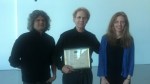
Shalom Auslander (L), Author and Contest Judge; Hillel Damron (C), winner: Nadine Epstein (R), Moment Editor

On Sunday, February 12, I was awarded Moment Magazine 2011 Memoir Contest first place prize. The award ceremony was held at the Spertus Institute in Chicago.  Here’s a short excerpt from the winning entry, “The Sweet Life:”                                                    

All the films that came to the kibbutz, crisscrossing the Jezreel Valley from place to place, were in 16mm, mostly Black & White, as was the film that night. They came spooled in tin reels, usually three or four, which required regular breaks in the action for the projectionist—by far the most important person in the kibbutz in my opinion—to replace them and start again. In addition, the film itself would break occasionally during each screening, evident by strange noises and pictures running in high speed on the screen. These unexpected breaks in the action had always seemed to occur, at least to me, at the most crucial, suspenseful moments.                                                                   

The adults, however, didn’t seem to mind one way or the other, and used these breaks for a variety of other things. First among them was the lighting of cigarettes, as almost everybody in the kibbutz smoked back then. Small flames flickered here and there, dotting the canvas of the dark lawn with color, before dying out into oblivion. Another favorite pastime activity was watching and pointing at the stars, and in later years at the Sputniks and Satellites floating slowly across the nightly skies. Some men used these breaks as an opportunity to relieve themselves in the nearby bushes. Shouts of all kinds, mainly announcements of urgent meetings or changes in work schedule, could be heard as well. A new mother would often be called to the babies-house, since her baby was crying for milk. There were hugs, kisses and feel-ups on the lawn. And between the blankets, rumors circulated through the grapevine, a baby or two were actually conceived.                                                                                                                  

Not me. I was conceived either on the boat of refugees bringing my parents, Holocaust survivors from Hungary, to Eretz Israel from Europe, or in the interment camp the British had brought them to after capturing their boat. It was probably a vacation for them there, compared with what they had gone through in the German concentration camps, since it was set up on the shore of the Mediterranean Sea. Somehow, they had both survived the horrors. But they had left behind in the burning chambers, among other relatives, my grandparents on both sides. Come to think of it now, there were no grandparents to be found in my kibbutz at all as I was growing up.                                    

Leave a Comment

Filed under Literary

Moment Magazine Memoir Contest Winner

On Sunday February 12, I was awarded Moment Magazine 2011 Memoir Contest first place prize. The award ceremony was held at the Spertus Institute — http://spertus.edu/moment – in Chicago.  Here’s a short excerpt from the winning entry, “The Sweet Life:” 

All the films that came to the kibbutz, crisscrossing the Jezreel Valley from place to place, were in 16mm, mostly Black & White, as was the film that night. They came spooled in tin reels, usually three or four, which required regular breaks in the action for the projectionist—by far the most important person in the kibbutz in my opinion—to replace them and start again. In addition, the film itself would break occasionally during each screening, evident by strange noises and pictures running in high speed on the screen. These unexpected breaks in the action had always seemed to occur, at least to me, at the most crucial, suspenseful moments.

The adults, however, didn’t seem to mind one way or the other, and used these breaks for a variety of other things. First among them was the lighting of cigarettes, as almost everybody in the kibbutz smoked back then. Small flames flickered here and there, dotting the canvas of the dark lawn with color, before dying out into oblivion. Another favorite pastime activity was watching and pointing at the stars, and in later years at the Sputniks and Satellites floating slowly across the nightly skies. Some men used these breaks as an opportunity to relieve themselves in the nearby bushes. Shouts of all kinds, mainly announcements of urgent meetings or changes in work schedule, could be heard as well. A new mother would often be called to the babies-house, since her baby was crying for milk. There were hugs, kisses and feel-ups on the lawn. And between the blankets, rumors circulated through the grapevine, a baby or two were actually conceived.

Not me. I was conceived either on the boat of refugees bringing my parents, Holocaust survivors from Hungary, to Eretz Israel from Europe, or in the interment camp the British had brought them to after capturing their boat. It was probably a vacation for them there, compared with what they had gone through in the German concentration camps, since it was set up on the shore of the Mediterranean Sea. Somehow, they had both survived the horrors. But they had left behind in the burning chambers, among other relatives, my grandparents on both sides. Come to think of it now, there were no grandparents to be found in my kibbutz at all as I was growing up.

Leave a Comment

Filed under Uncategorized

Unidentified Woman

A new Gideon Gold’s investigation mystery novel, a work-in-progress, is to be published this summer on Amazon Kindle and other E-reader outlets. Here is a short description:

Unidentified Woman is a story of rape, revenge, and redemption. A young Mexican girl, Maria Sanchez, is kidnapped on her way to school one morning. She is enslaved and repeatedly raped by paying costumers, mostly Americans. But she survives and grows up to become an independent young woman living in Los Angeles. She tracks down those men who wronged her, exerting a deadly, unusual punishment. On her footsteps, following the police’s failure to capture her, is a reluctant, amateur private investigator, Gideon Gold; a former commander of an elite Israeli paratroops unit and a Mossad secret agent. His frantic pursuit of the her takes unexpected twists and turns, culminating in a dramatic, compelling game of cat-and-mouse that will change both of their lives forever.

Leave a Comment

Filed under Uncategorized

The jaded detective and his young client

My novel, VERY NARROW BRIDGE, is available now for only $2.99 at Amazon Kindle. Please go directly to http://www.amazon.com/dp/B005L652QU and check it out. Or go to my literary website — http://hillelbridge.com/ — for further details. Here’s a new excerpt: “The reason for that eluded him. And yet, he was pleased with himself, his breathing getting in tune with hers. For once in his life, so unlike what had happened with Alma last night – and maybe, come to think of it, because of it – he was able to stare down temptation and come out on top. A winner for a change. Even if it was only one battle; even if the war, where the odds were clearly in her favor, was yet to be fought and won. Even if this seductive creature, lying here beside him, was holding him hostage. Preventing him from falling asleep. Forcing him to do some hard thinking, and to realize that the ease with which she had located her birth mother; a stroke of genius on his part, or maybe just pure luck, a one in a million shot, was not necessarily a good sign for the future. He suspected that some complications – latent energy, like the girl asleep now in his arms, so innocently and yet so ominously – may still lie ahead for her, and for him, down the road.”

Leave a Comment

Filed under Literary