
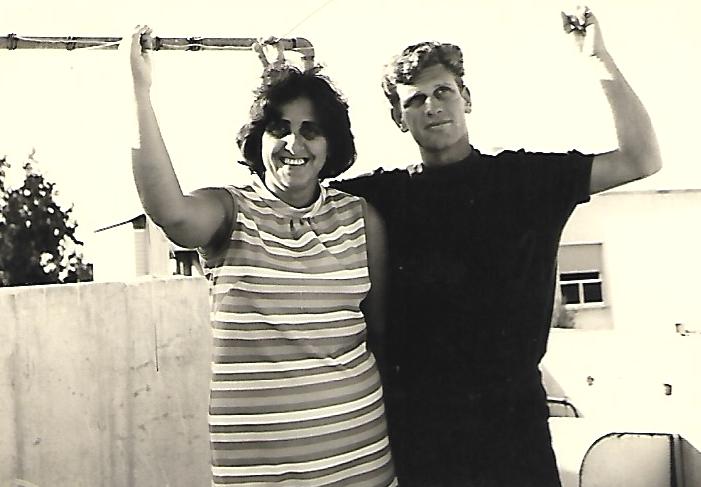
My mother, Hedva Hektin, passed away in Tel Aviv last October at the age of 96, a week before the terrible Hamas terrorist attack that has brought upon us this latest war. I’m convinced, mind and heart, that she sensed another calamity, another war was coming, and she just couldn’t live through it. She had enough, and finally left this world for good. I don’t hold it against her, though I hoped she would live even longer.
She never spoke of her experience in the Holocaust, shielding her offspring from the horror, as if it never happened. As if, by doing so, her children would never learn about it. This attitude was helped by the reality of living in a kibbutz, where the culture did—and so did she—everything possible to raise a ‘New Jewish Man.’ An ‘Israeli Man’; an Israeli Woman.’ A ‘Sabra.’ Who, as was the case with me, never heard his parents—unless visiting relatives in the city—speak Hungarian, their native language. Only Hebrew. As if, through their children, they were cleansing themselves not only from the atrocities they’d suffered in the ghettos and concentration camps, but also from their first circle of life.
My father—who heroically escaped three labor camps, and spent the last year of the war on the streets of Budapest while the Allies rained bombs, before the liberating Red Army had caught up with him—did speak freely in later years of his experience, and had left a recorded testimony for Yad Vashem. He shared with me what he knew about my mother who, together with her family, had been forcibly taken by the Nazis from their homes in the Hungarian city of Ungvár (now Uzhhorod, Ukraine) in 1944, loaded onto trains and shipped like cattle to Auschwitz. Out of some 10,000 Jews, few survived. My mother was among them.
She saw, at the age of eighteen, how her parents were taken away from her to the gas chambers, while she and her sisters were selected to the working force. But, as my father had told me, she also saw how her older sister—who’d refused to be separated from her baby, clutching him to her naked bosom—was taken away with her parents to the ovens of death. Recently, I learned from my sister—as had been told to her by one of our aunts—that she dropped naked on the dirty snow and refused to move, shouting hysterically that she didn’t want to live anymore. But her two other sisters picked her up and saved her. She outlived them all.
Years later, my mother was living already in Tel Aviv, married again quite happily, and already retired from her work at Histadrut Hamorim (The Teachers Union), before she would launch a ‘better late than never’ (if ever there was one!) acting career—a long dream of hers—achieving even a modest measure of success and fame. I was living in America by then, and if my memory serves me right, I was visiting Israel in 2002 when my father died in kibbutz Hephzibah, where he is buried. When my sad visit ended, I was scheduled to take the EL AL red-eyed flight to New York at midnight.
In the evening, the family had gathered around the dinner table in my mother’s small apartment in north Tel Aviv for a farewell dinner—my mother had become, through the years out of the kibbutz, also quite a good cook—when I yawned and mentioned how tired I was. No problem, someone had said, you’ll have plenty of time to sleep during the flight. Alas, since my days as a young security officer on EL AL airlines (in the heyday of terrorists’ kidnapping), I found it very difficult to fall asleep on flights. Still on guard duty, I remained, after all these years. So what, my mother had said, I’ll give you one of my sleeping pills. You can even take just half, it will put you to sleep nice and easy.
This to know, too, about my mother: as long as I can remember, she had the darkest circles under her eyes. Though I paid little attention to it while growing up, I do remember now that my father had mentioned once her reoccurring nightmares, and how frequently he had to calm her down during the nights. In short, after dinner, she gave me some of those pills, and off I went. Indeed, shortly after takeoff, I took half a pill as instructed. And what do you know, I slept—okay, not like a baby—but quite good for a couple of hours.
Upon reaching home, I stuck the remaining pills somewhere in the bathroom’s first-aid cabinet and forgot about them altogether. That was, until one night a few months later when I woke up around two in the morning from a bad dream. A real nightmare. I was so disturbed by it that I couldn’t fall back to sleep. Suddenly it hit me: Why not take the other half of that sleeping pill my mother had given me? Not thinking much of other possible consequences, health-wise, I took it. And then, lying in bed waiting for the drug to take its course, this question suddenly popped into my head: What my mother had been through at night all these years, following her experience in the Holocaust?
I lay there feeling bad for myself. For leaving her and Israel, in particular, I felt bad. What a baby you are, I told myself: You call that a nightmare?! Just think of what your mother had to remember—she had no choice, had she—all these years? Things you, with your overdeveloped imagination, cannot even dream of. The horrors. The abuse. The terrible separation from her loved ones. Who knows what the Germans did to her? Who knows what she had to do to survive? Your struggles and sufferings—a piece of cake. Your nightmares and sorrows—sweet candies compared with her bitter pills.
And so, unbeknown to her, she had taught me a great lesson. I forgave her everything right then and there, especially leaving my father and us kids in the kibbutz when she moved to the city, determined to fulfill her dreams. We children of Holocaust survivors carry this distinction like a birthmark, like the yellow badge, whether we want it or not. As a result, there’s an obligation ingrained in us: the need to learn this lesson and pass it along from generation to generation.
I heard her voice just then, whispering in my ear, crystallizing her lesson for me: Not to forget but to forgive; not to reminisce but to remember; not to falter but to persevere. And while there’s nothing new about that probably, for me it was a revelation. It was a lesson to be learned on an innermost personal level. She lived a life full of curiosity and hope. That was her secret. A life well lived. After all, how else had she survived the horrors of Auschwitz? Israel’s War of Independence and all the other wars to follow? Divorce, sickness, you name it. A son who was seriously injured in a major army operation.
A son who, like other second-generation survivors, would never really know what his parents had been through, and how they’d survived those horrors in the darkness. And yet, we are all obligated to remember and remind our children and the world about it.
And so I remember. And I remind myself, too, of what Primo Levi wrote In The Drowned and the Saved: “Once again it must be observed, mournfully, that the injury cannot be healed: it extends through time…”
Through time I will carry that torch, proudly, which my mother had passed on to me.


 Hillel F. Damron @ hillelbridge.com