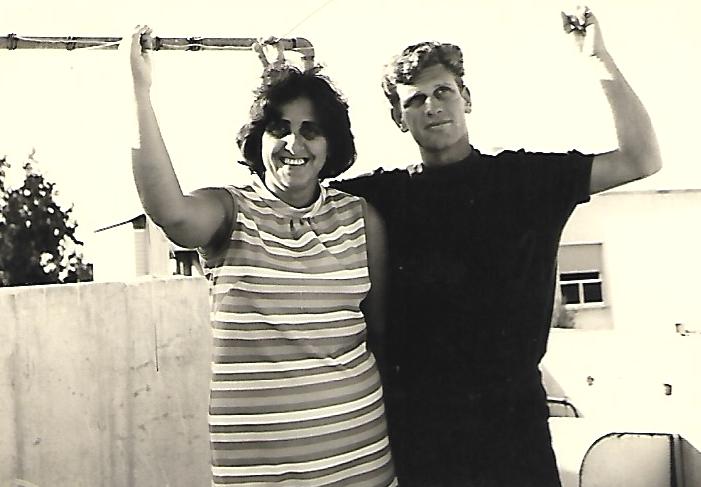
Mother and son on a rooftop in Tel Aviv, circa 1972
My mother, Hedva Hektin, passed away in Tel Aviv last October at the age of 96, a week before the terrible Hamas terrorist attack that has brought upon us this latest war. I’m convinced, mind and heart, that she sensed another calamity, another war was coming, and she just couldn’t live through it. She had enough, and finally left this world for good. I don’t hold it against her, though I hoped she would live even longer.
She never spoke of her experience in the Holocaust, shielding her offspring from the horror, as if it never happened. As if, by doing so, her children would never learn about it. This attitude was helped by the reality of living in a kibbutz, where the culture did—and so did she—everything possible to raise a ‘New Jewish Man.’ An ‘Israeli Man’; an Israeli Woman.’ A ‘Sabra.’ Who, as was the case with me, never heard his parents—unless visiting relatives in the city—speak Hungarian, their native language. Only Hebrew. As if, through their children, they were cleansing themselves not only from the atrocities they’d suffered in the ghettos and concentration camps, but also from their first circle of life.
My father—who heroically escaped three labor camps, and spent the last year of the war on the streets of Budapest while the Allies rained bombs, before the liberating Red Army had caught up with him—did speak freely in later years of his experience, and had left a recorded testimony for Yad Vashem. He shared with me what he knew about my mother who, together with her family, had been forcibly taken by the Nazis from their homes in the Hungarian city of Ungvár (now Uzhhorod, Ukraine) in 1944, loaded onto trains and shipped like cattle to Auschwitz. Out of some 10,000 Jews, few survived. My mother was among them.
She saw, at the age of eighteen, how her parents were taken away from her to the gas chambers, while she and her sisters were selected to the working force. But, as my father had told me, she also saw how her older sister—who’d refused to be separated from her baby, clutching him to her naked bosom—was taken away with her parents to the ovens of death. Recently, I learned from my sister—as had been told to her by one of our aunts—that she dropped naked on the dirty snow and refused to move, shouting hysterically that she didn’t want to live anymore. But her two other sisters picked her up and saved her. She outlived them all.
Years later, my mother was living already in Tel Aviv, married again quite happily, and already retired from her work at Histadrut Hamorim (The Teachers Union), before she would launch a ‘better late than never’ (if ever there was one!) acting career—a long dream of hers—achieving even a modest measure of success and fame. I was living in America by then, and if my memory serves me right, I was visiting Israel in 2002 when my father died in kibbutz Hephzibah, where he is buried. When my sad visit ended, I was scheduled to take the EL AL red-eyed flight to New York at midnight.
In the evening, the family had gathered around the dinner table in my mother’s small apartment in north Tel Aviv for a farewell dinner—my mother had become, through the years out of the kibbutz, also quite a good cook—when I yawned and mentioned how tired I was. No problem, someone had said, you’ll have plenty of time to sleep during the flight. Alas, since my days as a young security officer on EL AL airlines (in the heyday of terrorists’ kidnapping), I found it very difficult to fall asleep on flights. Still on guard duty, I remained, after all these years. So what, my mother had said, I’ll give you one of my sleeping pills. You can even take just half, it will put you to sleep nice and easy.
This to know, too, about my mother: as long as I can remember, she had the darkest circles under her eyes. Though I paid little attention to it while growing up, I do remember now that my father had mentioned once her reoccurring nightmares, and how frequently he had to calm her down during the nights. In short, after dinner, she gave me some of those pills, and off I went. Indeed, shortly after takeoff, I took half a pill as instructed. And what do you know, I slept—okay, not like a baby—but quite good for a couple of hours.
Upon reaching home, I stuck the remaining pills somewhere in the bathroom’s first-aid cabinet and forgot about them altogether. That was, until one night a few months later when I woke up around two in the morning from a bad dream. A real nightmare. I was so disturbed by it that I couldn’t fall back to sleep. Suddenly it hit me: Why not take the other half of that sleeping pill my mother had given me? Not thinking much of other possible consequences, health-wise, I took it. And then, lying in bed waiting for the drug to take its course, this question suddenly popped into my head: What my mother had been through at night all these years, following her experience in the Holocaust?
I lay there feeling bad for myself. For leaving her and Israel, in particular, I felt bad. What a baby you are, I told myself: You call that a nightmare?! Just think of what your mother had to remember—she had no choice, had she—all these years? Things you, with your overdeveloped imagination, cannot even dream of. The horrors. The abuse. The terrible separation from her loved ones. Who knows what the Germans did to her? Who knows what she had to do to survive? Your struggles and sufferings—a piece of cake. Your nightmares and sorrows—sweet candies compared with her bitter pills.
And so, unbeknown to her, she had taught me a great lesson. I forgave her everything right then and there, especially leaving my father and us kids in the kibbutz when she moved to the city, determined to fulfill her dreams. We children of Holocaust survivors carry this distinction like a birthmark, like the yellow badge, whether we want it or not. As a result, there’s an obligation ingrained in us: the need to learn this lesson and pass it along from generation to generation.
I heard her voice just then, whispering in my ear, crystallizing her lesson for me: Not to forget but to forgive; not to reminisce but to remember; not to falter but to persevere. And while there’s nothing new about that probably, for me it was a revelation. It was a lesson to be learned on an innermost personal level. She lived a life full of curiosity and hope. That was her secret. A life well lived. After all, how else had she survived the horrors of Auschwitz? Israel’s War of Independence and all the other wars to follow? Divorce, sickness, you name it. A son who was seriously injured in a major army operation.
A son who, like other second-generation survivors, would never really know what his parents had been through, and how they’d survived those horrors in the darkness. And yet, we are all obligated to remember and remind our children and the world about it.
And so I remember. And I remind myself, too, of what Primo Levi wrote In The Drowned and the Saved: “Once again it must be observed, mournfully, that the injury cannot be healed: it extends through time…”
Through time I will carry that torch, proudly, which my mother had passed on to me.
An old story, rewritten, echoing what took place in Israel during the months leading up to the October 7th massacre and the ensuing war.
David stayed in bed, not fully awake yet from a terrible dream. He blamed the uneasy feeling growing inside him on that dream, and at the same time resisted a strange need to go back to it. He fought that urge, trying to concentrate instead on listening to the birds outside, a habit of his for many years. They were calling on him to join them, but he wasn’t in a hurry to get up. It was Shabbat morning, after all, and beside him his wife Rosa was still asleep, snoring softly. He delayed also going to the bathroom, though the pressure on his bladder was very heavy, as was the case often lately, at this time of the morning. He was afraid, most of all, that he might wake up his dear ones: his grandson, his son, and his wife. They were all asleep on the open couch in the adjacent living room; tired, no doubt, from the festivities of last night.
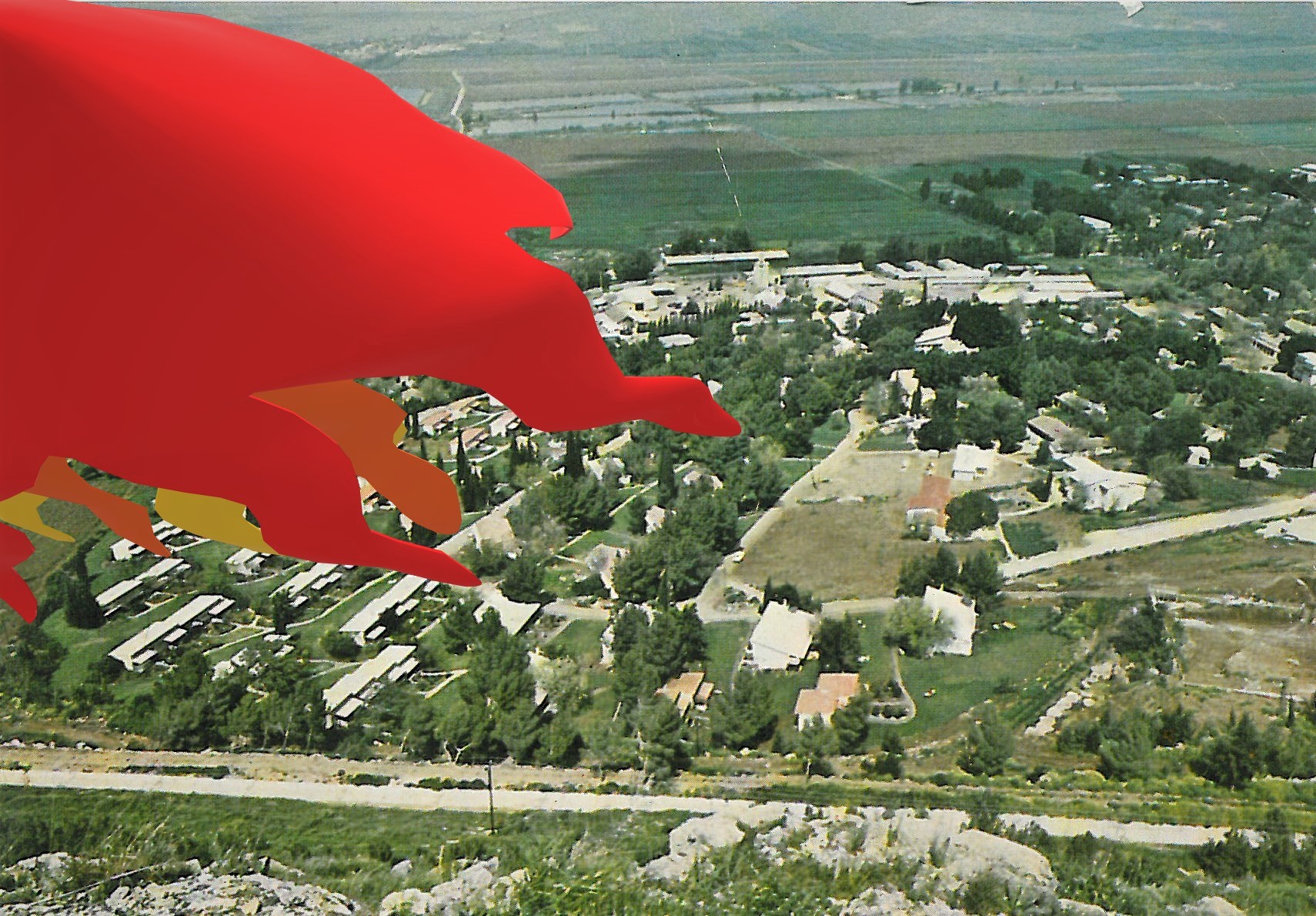
Yes, that was a real celebration, he reaffirmed to himself fondly. Sixty years ‘don’t go simply by foot,’ as today’s youth are so fond of saying. And as for the old, like himself, they should be proud of themselves for a day or two. Here, on the slope of the biblical Mount Gilboa, where King Saul and his son Jonathan had fought the Philistines, and where they heroically had died; here once only an infested swamp existed, but now stood proudly a beautiful, successful kibbutz.
This accomplishment was the basis and main theme of the colorful pageant performed last night at the new Community Center: The first days of Aliyah, the struggle and triumph that had followed in their footsteps, as the new Jewish immigrants conquered Eretz Israel. Of course, the presentation was done with the best that modern equipment
can offer these days, including audio-visual effects. And yet, it was the pure voice of the choir that had melted his heart so easily, singing those old Chalutzim songs. What a pity his son Gideon wasn’t among them; he always was such a fine singer. But that was before he’d got married and left the kibbutz. Before that city-girl of his had snatched him away from here for good.
A short cough came out of David inadvertently just then. He tried to strangle it but was too late. Rosa mumbled something first, then turned away from him and went back to sleep. He hoped his cough hadn’t woken up little Asaf: he needed the sleep, so he could grow up and be strong and healthy. And who knows, David thought wishfully, maybe one day his grandson would be the one to come back to the kibbutz.
He closed his eyes, trying to imagine such a favorable scenario. At the same time, the irresistible temptation, and warning too of that terrible dream came back to haunt him. It was possible, he couldn’t tell at first, that he did go back momentarily to visit the realm of that dream. Because suddenly—just as he felt how the mask of sleep was beginning to veil him yet again—he found himself in the bathroom, trying to relieve his urinary pressure. He stared at his bathtub while at it, trying to help things along by counting the tiles. Who would have believed back in the old days, he asked himself rhetorically, that one day we would have private bathtubs? What happened to the old Community Shower? And where are we heading, anyway, that we have homes with color televisions and landline telephones, and separate kitchens too with refrigerators and oven toasters? What will be the end of it all?
And suddenly—again, he was unsure how it’d happened so quickly—he found himself planted in the middle of his garden, wearing his black working shoes, his khaki shorts and gray undershirt. Apparently, he had drunk already his strong black coffee, and was ‘ready for wars,’ as his son had used to say. The kibbutz was still peacefully asleep. And why not, it deserved it after last night’s big celebration. Only he and the birds were awake. For them, it was a morning like any other morning: the Sixty-Year Anniversary of the kibbutz’s establishment meant nothing to them. The same could be said about Libi, his neighbor’s dog, a Border collie who kept running around his pecan tree for some reason. Right where his old, red bicycle was leaning on the trunk.
He stooped over his beloved daffodils, and despite the pain that was tormenting his lower back lately, began to methodically extract the wild weeds that were threatening to suffocate them. It was not so hard: only the crabgrass fought back, as it’d done for almost forty years now. It was a war without winners; it was a war without end. Like the war…
He straightened up abruptly, smelling smoke. His nose was especially sensitive to such smells, as Rosa his wife had pointed out not once. Yet he looked around and saw no sign of smoke, or fire for that matter. Not even a garbage barrel burning. The kibbutz was secure and serene as ever, and so was the mountain above it, with the Children Orchard nestled in the bosom of its slope. A pine tree for every child of the kibbutz was planted there, including for his own son and daughter. Luckily, Dalya was still living in the kibbutz. But how come she was yet to get married? Was yet to bear him grandchildren to play with, in his old age?
There was still hope, he believed, as he picked up the black hose and turned on the water. He placed his thumb on the mouth of the hose, so skillful at it, and created a perfect fan-shaped screen of silvery drops. He watered his garden with easy, steady moves, up and down, left and right. He always liked watering his garden this way, before the rainy season, as he expected, would begin in earnest. It made him feel alive, and so in tune with nature, especially when the soft morning breeze blew, as it did now, a few drops of water at his face. All his anxieties were gone by now, had been left behind in the house, in the bedroom, in the bed, in the dream.
But then, just as he was raising the water hose high in order to reach the row of hawthorn bushes framing his garden, he thought he saw smoke rising from somewhere. He threw down the hose and grabbed his old, reliable wooden ladder. Next—and again, it was so fast he couldn’t understand how it’d happened—he was high on a branch of the pecan tree, together with the black ravens. He looked over the roofs and trees, far away towards the valley below and its flat brown and green fields, bordered by placid fishing ponds glistening in the morning sun. He then turned his eyes over to the plastic factory and the cowsheds, all the way to the main yard of the kibbutz. Where he saw—clearly, he didn’t need his binoculars—a column of black smoke rising.
He was down on the ground in no time, and as a young man mounted his bicycle in one easy jump. He rode fast on the narrow pavement, cutting through residential neighborhoods, Libi running by his side, barking. They crossed the kibbutz in tandem along a cypress-lined dirt road, all the way down to the main yard. Only there, by the asphalt road that separated the kibbutz from the fields, did David come to a full stop in order to catch his breath. He was dumbfounded to see in front of him, right by the cowsheds, a big fire rising from the main hayloft, consuming quickly the hay bales, lined in straight rows twenty-fold high at the very least.
David couldn’t understand why the cowmen weren’t outside, even if they were busy milking the cows inside the dairy building. Libi was already there, and as if reading his mind, was calling on them to come out. But they didn’t hear her, how come? Nor did they hear the fire, which was very loud as it was devouring with great appetite the hay and straw bales, including also the wooden structure of the hayloft.
At the same time, to his astonishment, he saw the first orange flames flaring up from the roof of the plastic factory. And not so far away, where the white granary tower stood tall and proud, as if guarding the kibbutz, he noticed a funnel of gray smoke spiraling high up into the clear azure skies. Not only that—though here David was beginning to doubt whether he was seeing straight, or he was just imagining things—he thought he saw the shadows of people running between the various structures of the kibbutz’s main yard. Some shouting voices, as well, he thought he heard. And not in Arabic. In Hebrew!
He was back on his bicycle in a heartbeat, rushing towards the kibbutz’s dining room and the big lawn in front of it: his most cherished, greener lawn. For many years now, since tractors had replaced horses and had forced him out of the fields, David had been taking care of the landscape of the kibbutz. The lawns, the trees, and flowerbeds were his true soulmates; he knew every corner, turn and path in this old camp of his, even with closed eyes.
It was easy for him, therefore, to find the alarm wheel not far from the Community Laundromat. It was still hanging by a thick iron chain on a rusty crowbar under the ancient olive tree. ‘A real museum piece,’ his son had used to say, going back to the old days of the first Jewish Chalutzim who’d come to conquer this valley. The alarm wheel was sounded against random fires, or the occasional attack by Arab Fedayeens, calling on the members of the kibbutz to take up arms.
David almost fell when he came to a sudden halt by the olive tree, stumbling off his bicycle and letting it fall down on the ground. Better it than me, the thought flashed in his head, just as he grabbed the iron bar that was lying neglected on the ground for many years, and began hitting it on the wheel. He couldn’t understand how he muster the power to hit it so hard. But he did. And at first, the sound his strokes had produced was so pleasing to his ears, because it reminded him of long-past days.
Back then, everything had started and had ended here, near the big communal dining room. From here the farmers had departed before dawn to the fields and orchards, and from here members of the kibbutz had left late at night, at the end of the General Assembly, after the endless discussions and arguments regarding the future of the kibbutz had finally ended. At the small hours of the night, young lovers had stopped by here to grab something to eat, after making love out in the fields and vineyards.
Remembering those things, sweetly nostalgic, had energized David to continue hitting the alarm wheel full force, even though his ears were ringing by now, and his fingers were burning with pain. He instructed himself to continue at it, no matter what, the same way he had used to hit the hard, stubborn soil of the valley with his wide hoe: with all his might and inner conviction. And if his strength would take leave of him shortly, or his heart would stop beating suddenly and he would collapse on the ground dead—so be it. It was all the same for him anyhow, whether he would live or die. He did his best; he did his duty.
But then Ephraim arrived. He was the man responsible—back in those bygone, glorious days—for the discovery of the fires and for the equipment to fight them off. He carried his seventy years on his back like a sack of potatoes, but still, day and night, was attentive at all hours to the sound of the alarm wheel. Yet David, pushing seventy himself, refused to let go of the iron bar. Instead, he sent Ephraim down to the main yard, to the granary, to the silo, the plastic factory, and the cowsheds. So he did with Yariv, a reserve paratroops colonel who came running barefooted, still trying to put his short-sleeved shirt on. The high school kids began arriving soon, but David shook them all off and sent them away to the center of the fires. He was glued to the alarm wheel as if, this lifesaver of the kibbutz, were a limb of his own body.
Only when Rafi arrived, and gently but firmly extracted the iron bar from his hands, did David finally give in. After all, Rafi was his adopted son, and was still in the army, though his commander had sent him home for the festivities. He was a kid from the rough side of town, fatherless when he was brought to the kibbutz. Maybe he was paying David back for all those years of dedication by saving his life now. He helped him down to the green lawn a few meters away, then continued hitting the alarm wheel himself.
David, breathing hard and heavy, was anticipating that his heart would stop beating any second. He would end his life right here and now, he figured, on the big lawn in front of the dining room, on the day after the anniversary celebration of the establishment of his beloved kibbutz. Death will come to him at last.
His body felt very light suddenly. It was possible that it was lifted off the ground, and was carried up on the wings of a peaceful wind. At the same time, the thundering rings of the alarm wheel faded away, sounding more like the chime of sheep bells. It was as if he flew high above the kibbutz, its full beauty unfolding underneath him like an iridescent peacock’s tail. He landed on the summit of the mountain, flooded with a magnificent bright light, beside the memorial to his best friend: Yonatan.
Yonatan was the kibbutz’s shepherd back in the old days, and David remembered clearly the day he was informed of his death. He was murdered by a gang of Arab Fedayeens, damn them all. Slaughtered like one of his lambs. The kibbutz was in turmoil, its members in shock. The whole country, in fact, joined them in mourning. But what Yonatan would have said, had he known that first, the kibbutz had sold his cherished herd of sheep to Yusuf, the Israeli Arab lad who’d used to work with him; and second, that it had built a plastic factory where the sheep pen had used to stand?
These painful questions remained unanswered, because the face that David discovered staring at him after he’d finally come to, was not that of his old friend Yonatan—but that of his son, Gideon. He was supporting his father’s head, and was helping him into a sitting position. Beside him on the edge of the big lawn, right where David had fallen, was a bucket full of water. David no longer saw Rafi by the alarm wheel, which was dead silent now.
Gideon asked his father how he felt, and David assured him that he was feeling fine. Gideon was unconvinced, therefore took his shirt off and dipped it in the bucket, then handed it to his father. David wiped his face with it, and immediately felt even better; he felt how his breathing was calming down, while his rapid heartbeats were gaining a quiet, regular rhythm. He could hear voices shouting nearby, and some fiery explosions in the distance as well. He asked Gideon what was going on.
“The kibbutz is burning,” came the answer. “Some bandits from Beit She’an city had started the fire.”
Maybe his son did not want to alarm him. But it was strange, nonetheless, the calmness with which he’d said that. It was almost surreal. So David demanded to know what the situation was, to which Gideon answered that he—his father—had saved both the situation and the kibbutz. All able members were getting organized at full speed, and were rushing down to fight the fires and the invaders. Gideon wanted to help them, very much so. It was his home too, after all, even if he had left it some years ago.
These words were like music to David’s ears and soul; sweet and melodic as if he were hearing Brahms’ Hungarian dances for the first time again, back in the small Hungarian town where he was born. He told his son that he felt strong enough, and to prove his point he got up to a standing position. Somewhat dizzy, though, unsteady at first. He couldn’t see his bicycle by the olive tree, but that was all right with him; it was his contribution, he figured, to the kibbutz’s fighting efforts.
He didn’t hesitate at all and sent Gideon away to join the other kibbutz members in their fight. And Gideon, after patting his father’s shoulder, ran down with his bucket of water. Not much help in that, reflected his father, but the main thing was: his son’s sincere intentions. Still, he called on him to be careful—remembering well Gideon’s tendency for foolish brave acts, with accidents to follow—before he saw him disappearing behind the tall eucalyptus tree, guarding the dirt road leading down to the kibbutz’s main yard.
David walked slowly towards the dining room. He entered the restrooms first, washed his face and combed his shiny silver hair, plowing it with his wet, soil-cracked fingers. He smiled at the reflection of his rugged, sun-beaten face; he was still alive, lucky devil, and hungry too for the breakfast he’d missed eating this morning. So out he went into the main hall upstairs, finding it eerily deserted. How strange it was: most of the tables were left with plates full of food on them, morning salads and boiled eggs, with chairs thrown away disorderly on the floor. Only Ziva the Economist, the woman in charge of the kitchen and dining room, was there.
“What are you doing here, David, while everybody else is fighting the fire?” she reproached him harshly.
He couldn’t find a satisfying answer for her. Luckily for him, she hurried back to the kitchen. And he, no longer under her threat, sat down at one of the tables. He spread a generous layer of margarine over a slice of black bread and covered it with a thin layer of cherry jam. He poured himself a cup of dark tea, added a few drops of lemon to it, and ate and drank slowly. While at it, he surveyed the large hall, with anniversary decorations and old, brownish photographs from the first days of the kibbutz, hanging on its walls.
He remembered well that this was the first communal dining room in the Kibbutzim Movement, here in the valley-of-the-kibbutzim, to be built on a solid, concrete base, and not just a big tent or a wooden shack placed on bare ground. Years had passed since then, and the building had been renovated not once, yet the heart of the kibbutz was still beating here. And not only because members, and guests alike, still ate breakfast, lunch, and dinner here: it was because here were held the hilarious Purim parties, and here they danced the hora on Independence Day until dawn; here young men—and admittedly, not so young as well—ogled at the new Jewish women from the Diaspora who came to study Hebrew at the Ulpan, and at those half-naked blond shiksas from Scandinavia, volunteers who came to experience the kibbutz’s way of life. Here romances began to blossom, and here they matured into marriages. Here the weekly film was screened in the winter, and here still stood the upright black piano. Frantz, the kibbutz’s composer, had managed to sneak it out of Berlin somehow when he’d fled Germany before the war.
David trembled when he heard the first gunshot. He remained seated, though, thinking he may have heard Frantz hitting the piano keys. But then he heard a longer burst of gunfire, and couldn’t fool himself any longer. And yet, instead of going down to the main yard to find out what was going on, or more wisely, rush home to be with his wife and family, he asked himself this: Where did we go wrong? And how come these bandits from the development town nearby were doing this to us?
We helped them, didn’t we? At least ten of them were still working in the kibbutz, were they not? Two of them were even taking care of the old and sick. What a shameful situation it was, he bitterly reflected, that the members of the kibbutz couldn’t even take care of their own. Thank god—though since the Holocaust he’d doubted very much there was one—that he himself was not that old and frail yet.
He felt like smoking, but couldn’t find any cigarettes around. He’d quit smoking for quite some time now, following the advice of his doctor friend, his partner for a weekly game of chess. Rosa continued to smoke, unfortunately. Where was she now? In the house still, with Gideon’s wife and son? Maybe they all went up to the mountain already, as was the original plan, for a leisurely Shabbat hike?
All of a sudden, the vague voices calling and shouting from afar became louder and closer. Then a burning torch was thrown inside, coming directly at David through a wide window. He jumped aside and, as a young man defending his territory, got hold of the burning torch and threw it back outside through the shuttered window. But that was only the first torch. A second and third followed and soon the rioters entered too, like ants from all directions. They were armed with sticks and stones, even knives David saw flashing here and there. They began by turning the loaded tables upside down. Then the containers full of food were kicked and toppled.
One of the invaders noticed David, who stood helplessly, staring at him dumbfounded. It was Jacky Ben-Simon, who worked in the kibbutz’s plastic factory. His hand lifted a thick stick, and was about to lower it on David’s head.
“Why?” asked David.
“Why, I tell you why,” shouted Jacky. “Because you have everything, and we have nothing!”
“Not true,” called Sami, Jacky’s older brother who stood threateningly in front of David, his left hand holding a burning torch, the right hand raising a long, shiny knife. “It’s because you, damn Ashkenazim, got everything from the state. And we, poor Sephardim, got nothing!”
For a moment, hesitating, the brothers looked at the bewildered old man, before turning away without hurting him. They continued, nonetheless, in destroying and setting fire to his precious dining room.
At the same time, a group of kibbutz members reached the dining room as well, holding iron bars, fire extinguishers, hoes and pitchforks. A battle of life and death ensued. Some of the members fought the rioters, while others tried to extinguish the fire, aflame already in tables and curtains. The men from Beit She’an were also divided into two forces: One destroyed everything in sight and set fire to every corner, and the other defended against the kibbutz members.
David, stunned and pushed aside, saw his adopted son Rafi rushing into the fighting arena. Rafi was hitting left and right, so much so that it became difficult for David to determine which side he was on. Gideon, his own flesh and blood, was there as well. He got hold of his father and pulled him away forcefully. The last thing David had managed to see before they got out, an image he would carry with him to his grave, was how the fierce red flames began to eat the shiny black wood of the grand upright piano. The one that—like David himself—survived the Nazis.
They broke out of the fire and smoke, and into the open air of the big lawn. Many of the kibbutz residents were already there, among them women, children and the elderly. Some members with authority began the difficult task of moving them all away from the burning dining room.
“To the mountain. To the Children Orchard,” was the call that blew through the crowd like a sudden wind, its source unknown.
By that time, a new, organized group of kibbutz members had moved closer to the dining room. Yariv, the reserve paratroops colonel, was leading them on. They held rifles and even Uzi machine guns: battle-ready. Gideon, a reserve paratroops officer himself, told his father that he would like to try and stop them, see if he could mediate between the two sides. But his father held his arm firmly and ordered him to stay put.
“It’s not your battle anymore son, stay with me,” he said.
Just then Yariv shouted, “Acharay”—the legendary battle cry of the Israeli Army Commander, “follow me”—and charged in. His followers stormed in after him, firing their guns. The entire dining room was already burning by then, with black smoke streaming through its shuttered windows. Ferocious orange flames followed the smoke out and quickly spread fire to the green branches of the trees surrounding the old building.
When David saw that, he rushed down to the equipment shed, which stood adjacent to the old Community Shower—now serving the women as a beauty salon and a spa—and got hold of the longest water hose there. He hooked it to a faucet and turned on the water, and began fighting the fire. Other kibbutz members joined him in this fight, using water hoses and buckets of water, which they moved quickly from hand to hand. Some resourceful women brought towels and blankets from their beauty salon, and began beating the bushes, which by now caught fire as well. Everybody was at it, as one body, in a supreme, desperate effort to save the trees, the dining room, the kibbutz.
When at last fire engines from Afula, the capital city of the Jezreel Valley had arrived, together with police and ambulances, there wasn’t much that could be saved. The fire had been contained, to a degree, but the dining room was consumed down to its concrete base. The adjoining large kitchen, the bakery and the small warehouse, were also lost to the fire. The thick belt of trees and bushes enveloping the dining room had survived, however thin, due to the persistent, heroic effort of the kibbutz members.
There were casualties, of course there were, injured and dead. But at that hour of fatigue and grief, when David and Gideon were slowly walking up towards the mountain, dripping with sweat and water, it was unknown yet who and how many.
***
Dusk was descending on the kibbutz, whose residents had gathered on the slope of the biblical mountain. The sun had set down already—just as it had done so many years ago, after kissing the dead bodies of King Saul and his son Jonathan a last farewell—far behind the red Edom Mountains, high above the Jordan River. But the Jezreel Valley below was still drenched with her majestic golden light. A thick blanket of smoke covered the kibbutz, hanging low and heavy, while every few minutes or so, in a last rebellious attempt, an orange flame would flare up through the dark gray screen here and there, only to die down soon.
Under the Children Orchard, untouched by fire, they all huddled and sat down. The elderly were there, the veterans who’d come to this place when it was nothing but a swamp; parents with their children were there, even babies; the guests, too, sons and daughters of the kibbutz who’d returned home to celebrate the anniversary, like Gideon and his small family, and had stayed to fight the fire.
No one spoke. The atmosphere was thick with smoke and sorrow. Only the random burst of embers trying to reignite the fire, and the occasional wailing of sirens of the fire engines, ambulances and police cars, coming or leaving the kibbutz, occasionally broke off the dreadful, monotonous silence.
David was sitting high on a mountain rock, at the edge of this crowded group of people. His grandson Asaf was on his lap, secured by his tired arms. Close by on the ground his son Gideon was sitting, together with Dina his wife. David’s wife, Rosa, had been driven to the central valley hospital to be with Rafi, their adopted son, who was wounded in the battle. Their daughter Dalya was there as well, busy with other women handing everybody sandwiches, fruits and cold lemonade. A donation from the nearby kibbutzim.
Amos, the Secretary of the kibbutz, was the only one to stand up. His grave-looking face, with a bloodstained white bandage crowning his forehead, had told the story of the day before he even opened his mouth to speak. David heard his voice, but absorbed his words only partly. Some words registered in his mind immediately, and permanently, while others disappeared as if they were never uttered.
Yariv, the leader of the kibbutz’s resistance, was killed in the battle of the dining room. He—a veteran of the Six Days War, the War of Attrition and the Yom Kippur War—had died defending his kibbutz. Ephraim, the veteran firefighter of the kibbutz and David’s old friend, was dead too. His heart had failed him. Because, David knew for certain in his own heart, he was unable to extinguish the fire and stop the destruction.
The people from Beit She’an had suffered heavier losses. Six were dead, among them the brothers Jacky and Sami Ben-Simon, who’d been fired just last week from their work in the kibbutz’s plastic factory. The firing was the result of an ordinance issued by the Kibbutzim Movement, explained Amos apologetically, to employ only kibbutz members in the fields and factories whenever possible, and not “hired labor.” Maybe that was the reason, David now realized, why the brothers were so angry with him.
The list of damaged working places and burned-down buildings was infinite to the ears of the kibbutz members, so they asked Amos to be brief. There was no need to pour more oil onto the fire, they said, as it was still burning. So he ‘switched gears,’ as he so laconically had put it, and told the somber crowd that they may find some comfort in the knowledge that their kibbutz was not alone in this predicament. The chief of police from the town of Afula had informed him, in full confidence, that two other kibbutzim from the Republic of the Kibbutzim—“His words, not mine,” stressed Amos—were attacked in a similar fashion: One in the Galilee Mountains, up north, the other in the Negev Desert, down south. They were also the victims of an attack from nearby development towns. The police, as it was customary in such situations, had already assigned a name to the events of the day: The Red Shabbat.
A heavy, unbearable hush descended from the mountain at that time, and hugged this large group of people. The silence was interrupted occasionally by the sound of muffled cry coming hesitantly, as if from the collective chest of this grief-stricken, yet proud body of people. David noticed that Gideon had wrapped his arm around Dina’s hips, and that she, in turn, had leaned her head on his shoulder. He knew how rough the waters their boat was sailing on were. And yet, he couldn’t avoid thinking that maybe—just maybe—the terrible events of this day would bring them unity of hearts, and a renewed commitment and effort to stay together. And, who was wise enough to know, maybe it would bring them all back to the kibbutz one day soon.
Just as he was thinking that, the oppressive quiet was suddenly interrupted, when someone asked, “Where did we go wrong?” Asked, David was surprised to hear, the same question he himself had asked earlier in the dining room.
It was Zevik: He of the Chalutzim who had built this place; he who had planted the first citrus grove in the Jezreel Valley. “We were arrogant,” he answered his own piercing question, “and instead of paving roads for brotherhood, we built fences!”
“We succeeded, that’s our only fault,” called back Yoav, a young man from the third generation to be born in the kibbutz. “Why should we feel sorry for building such a beautiful, successful place?”
David listened quietly to the heated argument that followed. And at the same time he heard again what Jacky Ben-Simon had told him in the dining hall: “Because you have everything, and we have nothing!”
Suddenly, Moshe stood up. He was a kibbutz veteran of the second generation, and a History Professor in the College of the Kibbutzim. Very emotionally he gave his own mea culpa, declaring: “From its birth, our movement aspired to lead the camp forward, towards prosperity and equality for all. But we lost our way…“ he went on and on, losing David’s attention in the process.
But then Moshe paused and looked around, as if in the midst of lecturing his students, before concluding: “This is a crisis of values that we’re facing, because we worship the Golden Calf!”
At first, after Moshe had finished talking and had sat down on the ground, a shock of silence prevailed. But then came a torrent of different voices, protesting loudly, mainly from the young people. They were angry with Moshe for his attack, which in their view not only distorted the true reality, but was absolutely inappropriate for this most difficult of hours. Especially loud and sharp was Ziva, the Economist, who stood up and firmly stated: “There is no need to talk about a ‘Crisis of Values.’ Those were different days, back then!”
Yes, those were different days, remembered David. He would give it all back, gladly, if given the chance—the large swimming pool, the new Community Center, his color television, and porcelain bathtub—and return to the beginning. To the first days of Aliyah. To the labor-rejoicing of those days. Yes, they didn’t shy away from ideals back then. And the virtue of working the land was sacred, not cursed.
David kept these thoughts to himself. He was not a man of words: he was a man of actions. Like today, like the forty years he had lived and worked here in this kibbutz, transforming a mosquito-infested swamp into a blossoming garden. He had never dreamed, had never believed—there in the darkest of days when the Nazis had killed his parents and older brother—that it was possible to create such a beautiful, perfect place to live and work. And now–
“Now what?” cried a young voice suddenly, breaking David’s train of thought.
“What do we do now?”
Yair was just a schoolboy, who was yet to celebrate his Bar Mitzvah. But he stood up, unabashed, interrupting the older members of the kibbutz who were still immersed in their bitter, acute argument. They finally stopped quarreling and quieted down, listening reluctantly to Yair’s cry: “What do we do now?”
No response was possible. No attempt was made to give one. It was the most difficult hour of the kibbutz since the Chalutzim had arrived here sixty years ago in a small convoy of horses and donkeys. The first to come were all enlightened people, intelligentsia from Germany, professors of humanities and scientists of physics and chemistry; musicians and writers were among them too, as were industrial engineers. Later, in their footsteps, came the people from Eastern Europe, Holocaust refugees from Hungary—as David and his first wife, Gideon’s mother, were—Poland and Czechoslovakia. They all arrived here to the slope of this biblical mountain, their hearts beating with the hope of building a true commune; a utopian society; a paradisiacal, safe haven for the Jewish people.
And now, after fulfilling their dream, and after seeing it almost destroyed, here came a schoolboy who had shaken them all up with a simple question: “What do we do now?” A question they could find no answer to. Only silence and sadness they could offer, which had cast a terrifying shadow over them. At the same time, drops of sap began to slide slowly down the trunks of the pine trees in the Children Orchard, bringing with them moisture to David’s eyes and cheeks.
And it so happened just then that a sudden, divine sound was heard. It came as if from another place altogether: a fairytale kind of place. A biblical place. It was difficult to trace at first the source of that unearthly, sweet melody. It was a simple song about the joy of working the land, which the Chalutzim had used to sing in the early days. Other generations grew up singing that tune, as well. As was Orr, a son of the kibbutz who had come home for the anniversary celebration, and was playing it now on his little silver harmonica. Just as he had done in the old days, with a bunch of friends on the lawn by the swimming pool, on Erev Shabbat, tired after dancing the hora for hours on end, singing till dawn.
A low humming was now ascending hesitantly from this crowded group of people, as the tune got stronger, defying the heavy, painful silence. And then, as if Franz—his soul rising from the ashes of his burned piano—was conducting the choir again, a spontaneous, yet coherent singing by the kibbutz residents was heard, as they sang in one voice the old Chalutzim song.
David joined in the singing, raising his voice high. His grandson Asaf woke up startled, staring at him. But David continued to sing, even though he could remember clearly only the last stanza: “Shovel, pickax, hoe, and pitchfork; united together in a storm. And we will ignite again—again this earth—with a beautiful green flame!”
Gideon and Dina sang too, and so did Dalya, his daughter. They sang the songs of good old Eretz Israel being conquered and built anew. It was natural progress then, when Sarah, the veteran teacher of generations of the kibbutz’s children, appeared as if out of nowhere, and in her arms an accordion. She took the gentle tune that Orr had started with his harmonica, and transformed it into a more powerful sound. The people of the kibbutz didn’t need any instructions in order to surround her, young and old, as they began to dance the hora. Arm laced arm; hand held hand; united feet bounced off the ground with effortless ease.
Among the dancers was David, his left hand holding his son’s hand, his right arm hugging his grandson. Even the high school kids danced, and not because their discothèque—built where the old henhouse had used to stand—was burned down to the ground. There was a different reason for everything now: a reason that caused the people of the kibbutz to dance and rejoice again with the enthusiasm and dedication they experienced only in those early, first days of Aaliyah. All the pain and anger of that terrible day were pushed aside momentarily, as joy and yearning for a new beginning took over completely.
After a while, David resigned to his place on the old mountain rock. Only Libi, his neighbor’s dog, noticed him there and joined him. She squatted on the ground beside him, resting her head on his foot. He could still see in the dark below some remnants of the fire, flaring ablaze here and there.
His thoughts centered on Rafi, his adopted son, who was injured while defending the kibbutz. Maybe Rosa was back home already from the hospital. He could swear he heard her voice calling him just now. It was the kind of voice she had used only when trying to wake him up from a bad dream.
But this was not a bad dream: it was a good dream. And David didn’t want to wake up from it. He continued to sit motionless on the rock, drenched with the most expensive silver light, courtesy of the rising moon, shining down on him from above the mountain. He stayed there even after the last of the kibbutz members, exhausted from the events of the long day, had left. Just as his own family had done, too, believing that he had gone home already. But he had not. He remained, like the rock, quiet and still.
Below is the fifth segment of my new short story—’A Surprise Visit’—never before published.
filmsufi.com
Beni, who observed her movements with detached curiosity, turned his eyes away from her now and zeroed them instead—appreciatively so—on the nude woman in the painting. But Noa sat down again and, as if on purpose, blocked his view. Her bare legs were touching his, while she unzipped his bomber jacket.
“You’re not in the army anymore, Beni. Take off your battledress.”
“I’m a bit cold.”
“You’ll be warm soon.”
She sent an enticing smile at him, then poured more wine into their cups. They sipped it slowly, meditatively, looking at one another as if they were both back home after a long journey, rediscovering the color of each other’s eyes. He was the one to look away first, though, as he got hold of the present he’d brought with him and handed it to her.
She unwrapped it and looked fondly at the cover of The Lover, a book by A.B.Yehoshua. She opened it and read his dedication.
“Thanks, Beni. It’s a wonderful book.”
“You read it already?”
“Yes, but I don’t have it. And now I do,” she said and stuck her tongue out. “What about you?”
“What about me?”
“Did you like it?”
“I… I haven’t read it yet. It just came out a few–”
“Liar,” she said, cutting him off. She put the hardcover book aside and got hold of his shirt, pulling his face very close to hers. “I can still read you, Beni, like an open book.”
He smiled, a flush of pleasure stealing into his face. “And what do you read there?”
“Oh… let me tell you, sweetheart: an old-fashioned story about a lover who never truly loves.”
A heavy silence hung in the dense air now, as if not only suspended, but trapped as well in the limited space between them. They were both challenged by their shared memories, yet were dealing with them separately, differently. Noa was quicker to shake them off, as she finally let go of his shirt and opened some distance between them, still staring at him intently.
“What are you doing here in the city, anyway?” she asked.
“Not much.”
“Not much what?”
“Me and the Arab workers are building a university,” he said, a bitter smile playing on his face. “For the religious people.”
“You didn’t leave the kibbutz for that, did you?”
“And what if I did?”
“Nonsense. What do you want to study?”
He hesitated, unclear of his future plans. Or perhaps he was clear, just unsure about opening that door for her.
“I’m taking art lessons now,” she volunteered. “In the evenings.”
“I can see,” he said, looking again at the painting-in-progress on the easel. “I hope you’ll stick with it.”
“Of course I would. My crazy days are over.”
He looked at her closely, as a smirk was struggling to appear on his face.
Below is the fifth segment of my short story, ‘The Messiah,’ published originally in ‘Sambatyon, a Journal of Jewish Writing.’ The story is in an excerpt from my novel, ‘Very Narrow Bridge,’ published in 2011. Enjoy.
Gideon felt guilty when he opened the door to his apartment. He was about to hand over to a complete stranger the jam jar his father had given him before he left Israel, containing the dark brown soil – darker than anywhere else in the world, Gideon was convinced – he dug out from his garden. No wonder Gideon was remorseful. Even though he was certain that his father, not a young man himself, would’ve urged him to go ahead with it, had he known about it. What’s the problem, he would probably have said, I have enough soil in my garden.
Not only that. Gideon was planning on taking his son Daniel to Israel next Passover. And now, with some extra cash in the bank, he considered it a done deal. Which meant, quite obviously, that he would be able to fill as many jars, with as much soil from his father’s garden, as he could possibly take back with him. Maybe he’d open a business upon his return: “Soil from the Holy Land.” Why not. This is America, after all. Opportunity Land. And the business of America, as the cliché goes here, is business.
But the final argument that convinced him to reach for the jar, without demur, and take it to the dark cave with him, was this: His father, when he gave him the jar of soil, gave it to him for a reason. For a purpose. In the hope that somewhere, someday, someone might be in need of it. And what need could be greater than the need to please an old, bitter, ready to die Jewish man, who lost the hope of ever visiting Israel? Indeed, what better Mitzvah?
***
The door opened rather quickly this time, and Ben Landau grabbed the pizza and beers from Gideon’s hands without saying a word. He took it all to the kitchen table, filthy with leftovers, and dived right into it with the urgency of a man, if not that of a beast, who hadn’t eaten in the last two months.
His father, on the other hand, took the jar of soil with trembling hands and opened it. He put his index finger into it, gently as he could, and stirred the soil for a moment. Even smelled it. He then raised his index finger to his lips and kissed it, before setting his teary eyes on Gideon.
“I’m glad I’ve met you, Gideon.”
“So am I, Sid.”
“God sent you to me, I know that,” he said and recapped the jar carefully. Then turned his attention to his son, raising the jar.
Below is the fourth segment of my short story, ‘The Messiah,’ published originally in ‘Sambatyon, a Journal of Jewish Writing,’ in 2006. The story is in an excerpt from my novel, ‘Very Narrow Bridge,’ published in 2011. Enjoy.
“And Ray was in Vietnam, right?”
Sid nodded, suspiciously. “Is that why you’re looking for him, some old army business?”
“No, not at all. I was hired to find him. Family business.”
“What are you, a private dick or something?”
“Kind of. My first case here in America, actually.”
“I see… an immigrant trying to make a buck.”
Gideon nodded.
“What’s in it for me then?”
Good question, as far as Gideon was concerned. And the first sign that Sid knew, maybe, something concrete.”
“Name your price, Mr. Landau.”
“Now he’s talking,” shouted Ben from his corner, where he was busy watching a portable TV set, resting on the kitchen counter. “Finally talking.”
“Shut up, Ben. What you watching?”
“Gilligan’s Island.”
“Then watch it and be quiet. I’m not going to take any money from an Israeli soldier.”
“Why not?”
“I’ve got principles, that’s why.”
His son answered that by filling his mouth with air, then punching his blown-up cheeks with both fists, producing a fart-like noise.
“Do you believe, Gideon, that I’m a man of principles?”
“I sure do.”
“Then you’re my man, son. Do you have anything from Israel that you can give me?”
“What: pictures, books, records?”
“No, I’ve got plenty of those. What else do you have?”
Gideon looked around, feeling caged – no escape in sight.
“An Ozi or two will do,” suggested Ben.
Gideon stared at him coldly and shook his head. But then he remembered something, and spoke before he had the chance to give it a second thought.
“I have some soil from Israel, actually, if–”
“Soil!” cried the old man.
“That’s right. From my father’s garden, in the kibbutz.”
“Then bring it over, son, on the double. I need it for my grave.”
“You’re crazy, Dad,” shouted the real son, “he’ll go out and dig some dirt outside. How can you–”
“Shut up, Ben, how many times I have to tell you,” said the annoyed father. “He’s not like you and me, got it? He’s an Israeli, born and bred. A kibbutznik, no less. A double-sabra. They don’t cheat over there. Right, Gideon?”
“Right,” confirmed Gideon, who was not about to dispute – not at that moment, anyhow – the old man’s idealized notion of his birthplace.
“So go home, young man, and bring me soil from the Holy Land. A place I will never see in my own dying eyes.”
Gideon felt the need to say an encouraging word here, but was afraid he would just aggravate the situation even more by doing so. So he retreated to the door and opened it, allowing a flood of bright sunlight to wash this dark cave. The rain was gone, it seemed, unforeseen as when it suddenly had arrived.
“You’ll get some valuable information about Ray in return,” promised Sid.
“Good. It will take me two hours or so. I live in the Valley.”
“In the Valley… what on earth for?”
“I’m a Valley Boy, Sid, I was born in the Jordan Valley. I guess I will die in a valley.”
“Suit yourself. I’m not going anywhere, as you can see,” said the old man and tapped lightly on his knees. “Bring with you a Supreme Combo pizza, too, with everything on it. If you don’t mind.”
“Sure thing.”
“And a six-pack of Miller Light,” shouted Ben from his corner, just before Gideon closed the door.
Below is the first segment of my short story, ‘The Messiah,’ published originally in ‘Sambatyon, a Journal of Jewish Writing,’ in 2006. The story is in an excerpt from novel, ‘Very Narrow Bridge,’ published in 2011. Enjoy.
The heavy rain, powered by gusty winds, made it very difficult on Gideon Gold to navigate his way to Beach Lane. Not that it would’ve been easy to locate on a normal, sunny day, since it was just an enclave of sorts; stuck, shapeless, between Main Street and the beach. Not far from where, luckily, he found a place to park by the curb.
He stayed in his car, watching hypnotically a narrow strip of gray ocean, thinking – as he was inclined to do whenever he watched the ocean, or at other unscheduled moments in time and place – of his life, and of home, and of the past and of the future. Longing for his apartment by the Mediterranean Sea, in Tel Aviv, where people spoke his language; where he showed some promise as a writer and filmmaker; and where he left so many beginnings unfinished.
He couldn’t comprehend, all of a sudden, what he was doing here in Santa Monica. He felt weakness in his stomach. A familiar feeling of dread, unreasonable dread, engulfed him like the sea. He couldn’t put his thoughts, in Hebrew, into words in English. He had no idea what he was going to say to Sid Landau, if he ever found him, and how he was going to explain to him his involvement in the mysterious disappearance of Raymond De Rosi and his daughter. He was his old self again: the consummate procrastinator. He was in trouble.
But trouble was Gideon’s current territory, his battleground – constantly triggering his memory. And he remembered, while apprehensively considering his next move, that there were certain situations, as a wise Jewish man once observed, when one had to break into the fortified city through the sewer tunnels. King David, he followed this line of thought, took a similar step with the water tunnels when he first captured Jerusalem. That’s how he remembered it, anyhow, from his bible lessons in the kibbutz. And remembering these things – even if their exact meaning was not yet entirely clear to him – helped Gideon and encouraged him to continue. Reenergized, he got out of his car, leaving his hesitations behind.
Ahead of him stretched a narrow-paved path, which led to the “Santa Monica Studios Complex,” and kept going straight in the middle of the lawn, split¬ting in half two rows of small bungalows. On the wall of the first one, being used as a laundry room, Gideon saw an old, over-used public telephone stuck on the wall, surrounded by graffiti. And on the next door, number two, above the mailbox slot, he found the name he was looking for: LANDAU.
He rang the bell once and waited. Then rang a second time and waited even longer. He rang a third time, too, thinking of retreating and trying later, since the rain was still at it, and he was – true to form, as if a Californian by birth – without an umbrella. He already turned to go, cursing to himself, when the door opened suddenly and he found himself facing a pudgy man in his late twenties, standing behind a rusty screen door. He wore shorts and a dirty sleeveless shirt, holding an open, half-full bag of potato chips in his hand. He looked at Gideon with watery eyes and said nothing, chewing a potato chip loudly.
Below is the seventh segment of a new short story—’You Won’t Believe This’—never before published. As I say at its beginning, I’m telling you this incredible story to: “Test your core belief in the divine, or your firm conviction in reality and reason.” Enjoy the ride.
Suddenly, I felt a pull of unbearable sorrow deep inside me. It forced me to look back at the sea, still desperately searching for answers to my life’s big questions. I saw how the sun was kissing the sea goodnight, and concluded that everything streams into darkness, and every soldier must die alone, as we’d used to sing in the army. When darkness comes, I decided then and there, I would walk barefoot to the beach and enter my sea of sadness completely naked. I would swim deep and far, and plow the dark waters all the way to the “Voice of Peace” boat, or even deeper and farther than that, why not, in search of the dying sun, as I’d used to daydream as a child. I would go after her, yes I would: into the heart of darkness, into the depth of sea.
I stretched my hand to grab my lemonade glass, intending on giving it one more try, and that when the telephone rang. It shook me up all right, I tell you, since I didn’t expect anybody to remember I still existed. Hard to believe, but I didn’t have an answering machine back then, or a long enough cord in order to bring the intruding instrument out into the balcony. It could be my mother, I thought at first, inquiring whether I tasted her chicken already. Or maybe my father was calling, demanding to know when, if ever, I intend on coming back to the kibbutz. It was possible, also, that my son was the caller, eager to tell me about his new school. Even that semi-producer, what was his name, was perhaps calling me to ask if I did the rewrite already.
Either way, whoever was calling me was persistent enough to force me, after about three rings, to get up and finally stepped back into the living room, close by the sliding glass doors, and pick up the receiver.
“Hello…” I said.
The reply came from a different direction altogether. You won’t believe this, I know, but I heard a loud, strange noise coming from the balcony. And as I looked back, still holding the receiver to my mouth and ear, I saw a large cinderblock falling down from the ceiling above my balcony, landing heavily on my beach chair. It gave wings to a cloud of dust, and a fan of debris that was spreading around, shaking the lemonade in my glass.
Automatically, repetitively, I kept saying “Hello” into the mouthpiece. But here’s the kicker, my friends: no one answered back. Nor did I hear the hanging up of the phone on the other side. No static or heavy breathing could be heard, either, just dead silence. The kind—you know what I mean, don’t you? —that makes one certain that someone is actually there, on the other end of the line, listening to you very carefully.
Slowly, ever so slowly, I hung up the receiver and stepped back into the balcony. Dumbfounded, I stared at my beach chair, crashed to the floor under the weight of the cinderblock, right where I’d been sitting before the phone had rung and had called me away. I looked up at the ceiling, but saw no naked women there, just an empty hole, opening up into the darkening skies.
Below is the sixth segment of a new short story—’You Won’t Believe This’—never before published. As I say at its beginning, I’m telling you this incredible story to: “Test your core belief in the divine, or your firm conviction in reality and reason.” Enjoy the ride.
A blast of bright sunlight, full-faced, and a strong sea breeze greeted me. Exposed and spread in front of me was the familiar, yet still magnificent expanse of the Mediterranean Sea, stretching wide-open all the way to the end of the world. May it will come soon, that end, I whispered a prayer; a hypocritical prayer, mind you, coming from the mouth of a devout nonbeliever. Maybe a jump down to the busy road below would do the trick, and would bring me that desired finale.
But wait a minute, I remember telling myself: here, my friend, was the sea. Your sea. Blue all right, with whitecaps and silver brushstrokes here and there, sailing boats, surfing boards, wave riders, paddle boards, flying seagulls and cresting, rolling waves breaking into foam on the sandy beach. You name it, beach-wise I mean, it was there. Including the hill of the Independence Gardens on the right, and the marina by the Seaside Hotel on the left, creating a triangle-like bay, which opened up wide into the sea.
The beach itself, normally crowded to capacity, was relatively roomy and airy that late afternoon. And therefore much more enticing. Give me a good reason, I challenged myself, why I shouldn’t go down for a swim; see if the waves still remember me. And then, fair game, pursue a careful study of the half-naked girls lying there on the sand, sun-worshiping. With any luck, I may bring one home with me. I had dinner to offer her, an aphrodisiac courtesy of my mother, which would surely smooth her way into my bedroom, and stimulate the lovemaking to follow.
Yet even that intriguing idea inspired no urgency in me that day. I felt no vitality in my veins; no rush of blood anywhere; no burning desires or uncontrolled urges were left in me. I dropped down on the beach chair and stretched my tired legs forward on the floor. I could still see the sea, peeking at me through the peeling cement rails lining my balcony. And though I searched for answers there, I found only sadness reflected back at me from the waves. It was magnified by the sun: a big ball of fire coming down for a swim. She was blood-red, just as I imagined the heart of the world to be. One has to witness such a sunset at least once, I was convinced back then, before one dies.
I took a sip of lemonade, but it tasted not as it had tested yesterday, or the day before. It was bitter, not sweet. For some reason—unclear to me at the time—I looked up at the ceiling above me in the balcony and stared hard at it, as if seeing it for the first time. I saw that, like an abstract painting, it was full of cracks. Deep cracks, mind you, deeper than what I’d noticed before. And over on the other side, I deliriously imagined, my landlord’s daughter and her girlfriend were nakedly embraced, soaking up the last sunrays of the day.
Below is the fifth segment of a new short story—’You Won’t Believe This’—never before published. As I say at its beginning, I’m telling you this incredible story to: “Test your core belief in the divine, or your firm conviction in reality and reason.” Enjoy the ride.
In a personal act of defiance and protest—probably my last such act—I tuned instead to the “Voice of Peace,” Abie Nathan’s radio station, which he operated in those days from a boat out in the sea. It faithfully transmitted, at all hours of the day and night, golden oldies and classic rock, mixed with messages of peace, directly through the air and over the waves of the sea at the window of my bedroom, and at the balcony of my apartment.
Next, I glanced in dread at my writing desk, situated strategically in a shaded corner of the room. On top of the desk, beside my green Hermes typewriter, rested my latest screenplay: Love under the Eucalyptus Tree. (You may laugh, why don’t you, I’m laughing too.) The one about the kibbutz, where my father, good health may always be with him, still lived. He deserves a call, too, I was thinking, and a mention in my final writing paper as well. After all, this screenplay was in large part about him: A Holocaust survivor, a socialist, an eternal idealist and dreamer. A curse and affliction I no doubt inherited from him. No wonder I turned out so screwed up.
True to form, and to that conclusion, I was planning on directing the film myself. It was supposed to be my film, you see, my singular work of art. I would finally create a splash here in the city, and make a name for myself to go along with it. Would rescue my future, hopefully, from the jaws of my past. Would prove to all those city-type people that I, a farm-boy from the Jezreel Valley, was capable of more than just these lousy video magazines. Even though, cut to the naked truth here, the copies I’d made so far of my screenplay, with considerable costs (money originally set aside for my monthly rent), kept coming back to me from those pretentious, brainless producers, and their fake production companies. Always rejected.
Rejected and dejected was how I felt that afternoon. I couldn’t go through another rewrite. No way. Even that, sitting at my desk writing—the one thing I liked doing the most—was too much for me on that ominous, albeit sunny day in Tel Aviv. Instead, I put my hand on the phone, resting on the broken, small black & white television set, intending on calling my son. See how he was doing. Yet I hesitated, my phone anxiety taking over big time, as I realized I would probably have to speak with her first. His mother. My wife still, officially. It was the worst, talking to her. I just couldn’t bring myself into doing that. Not now—not ever.
I opened the two sliding glass doors that separated my living room from the balcony, parted them wide and stepped outside. I placed my cold lemonade glass on the small round table, standing by my old beach chair, and raised the dusty green shades all the way up. It was like raising a curtain, as they used to do back then at the old, grand Tel Aviv Cinema Theater in town, before the screening of each film. Let it begin; I was ready for the end.
Below is the fourth segment of a new short story—’You Won’t Believe This’—never before published. As I say at its beginning, I’m telling you this incredible story to: “Test your core belief in the divine, or your firm conviction in reality and reason.” Enjoy the ride. I opened the door to my apartment and entered, immediately throwing my worn-out leather briefcase on the floor in disgust, and the mail on the messy dining room table. I first went to the bathroom for a quick pee, which nonetheless lasted too long. Damn—even that simple task was not as easy for me to accomplish that day, as it had always been. Next, I released my sore feet from the burden of my biblical-style sandals and undressed, remaining in my checkered boxer shorts and sweaty white T-shirt.
As I entered the kitchen, I immediately noticed that my sink was clean spotless, empty of the dirty dishes I’d accumulated there in the last week. In the fridge, I first found my lemonade pitcher not almost empty, as I’d expected to be, but full. And then, another clear evidence that my mother, bless her heart, had been here ahead of me today: she’d left behind a large jar of pre-made chicken soup, as well as a pre-cooked dinner. Chicken, of course, with brownish fried potatoes and cooked green peas on the side. It would probably last me for the next three days, I figured, if I remained alive that long. Which I very much doubted.
In hindsight of many years, my mother’s charitable acts were the first indication that something good—what exactly even my crazy mind could not have guessed, or imagined possible—might still be cooking up for me. She was so worried about me lately, and decided to take over certain responsibilities, since my wife had left me. Had left to pursue her “artistic” aspirations, you see, as if she’d ever cared much about cooking dinner for us while we were still together as a family.
I should call her later. My mother, of course, not my wife. Her next call would come from the police, or from the morgue, informing her of my suicidal death. As for my mother, I would wait a while longer before calling her. Maybe I never would. I hated telephones the most, I really did. In the kibbutz, where I was born, I grew up without the hateful instrument. I never got used to it, here in the big city; so impersonal it had always sounded to me. And so deceiving, too: you can easily lie, if you so wish. Which I could never successfully accomplish—no kidding—no matter how hard I tried.
In any case, I’ll be sure to thank my mother in my suicide note, I decided as I entered the living room. Where, despite my gloomy mood and bleak outlook, I automatically turned on the radio, which was tuned permanently to a station (Voice Aleph, I believe it was) that played mostly classical music in the afternoon. But of course, not on that fateful day. On that day news took over, drumming the sounds of war after a night of skirmishes on the northern border. Oh man, how much I hated the news that day. And the wars, of course. Always the wars.




 Hillel F. Damron @ hillelbridge.com