Tag Archives: politics

The Kibbutz is Burning

An old story, rewritten, echoing what took place in Israel during the months leading up to the October 7th massacre and the ensuing war.
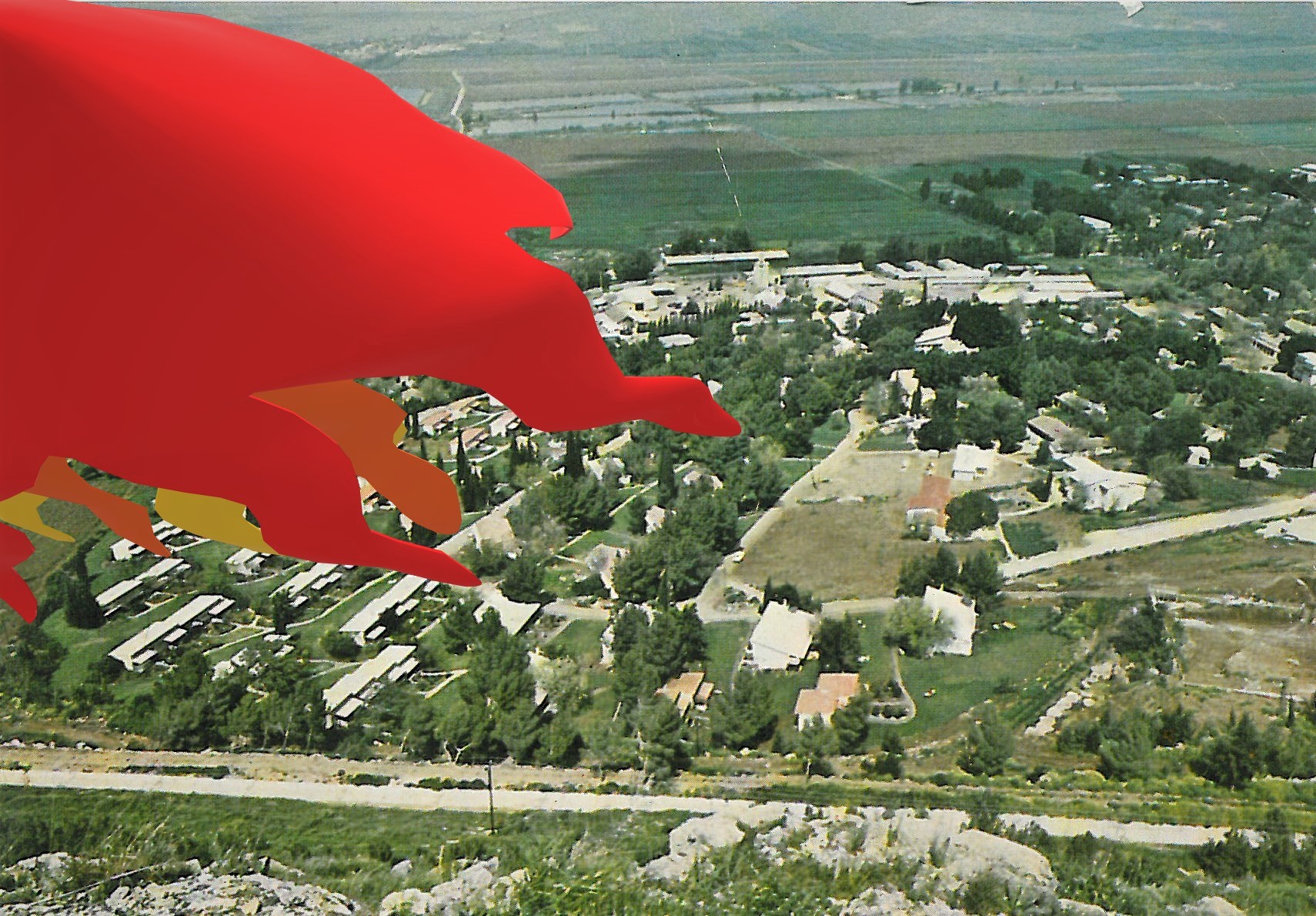
David stayed in bed, not fully awake yet from a terrible dream. He blamed the uneasy feeling growing inside him on that dream, and at the same time resisted a strange need to go back to it. He fought that urge, trying to concentrate instead on listening to the birds outside, a habit of his for many years. They were calling on him to join them, but he wasn’t in a hurry to get up. It was Shabbat morning, after all, and beside him his wife Rosa was still asleep, snoring softly. He delayed also going to the bathroom, though the pressure on his bladder was very heavy, as was the case often lately, at this time of the morning. He was afraid, most of all, that he might wake up his dear ones: his grandson, his son, and his wife. They were all asleep on the open couch in the adjacent living room; tired, no doubt, from the festivities of last night.

Yes, that was a real celebration, he reaffirmed to himself fondly. Sixty years ‘don’t go simply by foot,’ as today’s youth are so fond of saying. And as for the old, like himself, they should be proud of themselves for a day or two. Here, on the slope of the biblical Mount Gilboa, where King Saul and his son Jonathan had fought the Philistines, and where they heroically had died; here once only an infested swamp existed, but now stood proudly a beautiful, successful kibbutz.

This accomplishment was the basis and main theme of the colorful pageant performed last night at the new Community Center: The first days of Aliyah, the struggle and triumph that had followed in their footsteps, as the new Jewish immigrants conquered Eretz Israel. Of course, the presentation was done with the best that modern equipment

can offer these days, including audio-visual effects. And yet, it was the pure voice of the choir that had melted his heart so easily, singing those old Chalutzim songs. What a pity his son Gideon wasn’t among them; he always was such a fine singer. But that was before he’d got married and left the kibbutz. Before that city-girl of his had snatched him away from here for good.

A short cough came out of David inadvertently just then. He tried to strangle it but was too late. Rosa mumbled something first, then turned away from him and went back to sleep. He hoped his cough hadn’t woken up little Asaf: he needed the sleep, so he could grow up and be strong and healthy. And who knows, David thought wishfully, maybe one day his grandson would be the one to come back to the kibbutz.

He closed his eyes, trying to imagine such a favorable scenario. At the same time, the irresistible temptation, and warning too of that terrible dream came back to haunt him. It was possible, he couldn’t tell at first, that he did go back momentarily to visit the realm of that dream. Because suddenly—just as he felt how the mask of sleep was beginning to veil him yet again—he found himself in the bathroom, trying to relieve his urinary pressure. He stared at his bathtub while at it, trying to help things along by counting the tiles. Who would have believed back in the old days, he asked himself rhetorically, that one day we would have private bathtubs? What happened to the old Community Shower? And where are we heading, anyway, that we have homes with color televisions and landline telephones, and separate kitchens too with refrigerators and oven toasters? What will be the end of it all?

And suddenly—again, he was unsure how it’d happened so quickly—he found himself planted in the middle of his garden, wearing his black working shoes, his khaki shorts and gray undershirt. Apparently, he had drunk already his strong black coffee, and was ‘ready for wars,’ as his son had used to say. The kibbutz was still peacefully asleep. And why not, it deserved it after last night’s big celebration. Only he and the birds were awake. For them, it was a morning like any other morning: the Sixty-Year Anniversary of the kibbutz’s establishment meant nothing to them. The same could be said about Libi, his neighbor’s dog, a Border collie who kept running around his pecan tree for some reason. Right where his old, red bicycle was leaning on the trunk.

He stooped over his beloved daffodils, and despite the pain that was tormenting his lower back lately, began to methodically extract the wild weeds that were threatening to suffocate them. It was not so hard: only the crabgrass fought back, as it’d done for almost forty years now. It was a war without winners; it was a war without end. Like the war…

He straightened up abruptly, smelling smoke. His nose was especially sensitive to such smells, as Rosa his wife had pointed out not once. Yet he looked around and saw no sign of smoke, or fire for that matter. Not even a garbage barrel burning. The kibbutz was secure and serene as ever, and so was the mountain above it, with the Children Orchard nestled in the bosom of its slope. A pine tree for every child of the kibbutz was planted there, including for his own son and daughter. Luckily, Dalya was still living in the kibbutz. But how come she was yet to get married? Was yet to bear him grandchildren to play with, in his old age?

There was still hope, he believed, as he picked up the black hose and turned on the water. He placed his thumb on the mouth of the hose, so skillful at it, and created a perfect fan-shaped screen of silvery drops. He watered his garden with easy, steady moves, up and down, left and right. He always liked watering his garden this way, before the rainy season, as he expected, would begin in earnest. It made him feel alive, and so in tune with nature, especially when the soft morning breeze blew, as it did now, a few drops of water at his face. All his anxieties were gone by now, had been left behind in the house, in the bedroom, in the bed, in the dream.

But then, just as he was raising the water hose high in order to reach the row of hawthorn bushes framing his garden, he thought he saw smoke rising from somewhere. He threw down the hose and grabbed his old, reliable wooden ladder. Next—and again, it was so fast he couldn’t understand how it’d happened—he was high on a branch of the pecan tree, together with the black ravens. He looked over the roofs and trees, far away towards the valley below and its flat brown and green fields, bordered by placid fishing ponds glistening in the morning sun. He then turned his eyes over to the plastic factory and the cowsheds, all the way to the main yard of the kibbutz. Where he saw—clearly, he didn’t need his binoculars—a column of black smoke rising.    

He was down on the ground in no time, and as a young man mounted his bicycle in one easy jump. He rode fast on the narrow pavement, cutting through residential neighborhoods, Libi running by his side, barking. They crossed the kibbutz in tandem along a cypress-lined dirt road, all the way down to the main yard. Only there, by the asphalt road that separated the kibbutz from the fields, did David come to a full stop in order to catch his breath. He was dumbfounded to see in front of him, right by the cowsheds, a big fire rising from the main hayloft, consuming quickly the hay bales, lined in straight rows twenty-fold high at the very least.

David couldn’t understand why the cowmen weren’t outside, even if they were busy milking the cows inside the dairy building. Libi was already there, and as if reading his mind, was calling on them to come out. But they didn’t hear her, how come? Nor did they hear the fire, which was very loud as it was devouring with great appetite the hay and straw bales, including also the wooden structure of the hayloft.

At the same time, to his astonishment, he saw the first orange flames flaring up from the roof of the plastic factory. And not so far away, where the white granary tower stood tall and proud, as if guarding the kibbutz, he noticed a funnel of gray smoke spiraling high up into the clear azure skies. Not only that—though here David was beginning to doubt whether he was seeing straight, or he was just imagining things—he thought he saw the shadows of people running between the various structures of the kibbutz’s main yard. Some shouting voices, as well, he thought he heard. And not in Arabic. In Hebrew!      

He was back on his bicycle in a heartbeat, rushing towards the kibbutz’s dining room and the big lawn in front of it: his most cherished, greener lawn. For many years now, since tractors had replaced horses and had forced him out of the fields, David had been taking care of the landscape of the kibbutz. The lawns, the trees, and flowerbeds were his true soulmates; he knew every corner, turn and path in this old camp of his, even with closed eyes.

It was easy for him, therefore, to find the alarm wheel not far from the Community Laundromat. It was still hanging by a thick iron chain on a rusty crowbar under the ancient olive tree. ‘A real museum piece,’ his son had used to say, going back to the old days of the first Jewish Chalutzim who’d come to conquer this valley. The alarm wheel was sounded against random fires, or the occasional attack by Arab Fedayeens, calling on the members of the kibbutz to take up arms.

David almost fell when he came to a sudden halt by the olive tree, stumbling off his bicycle and letting it fall down on the ground. Better it than me, the thought flashed in his head, just as he grabbed the iron bar that was lying neglected on the ground for many years, and began hitting it on the wheel. He couldn’t understand how he muster the power to hit it so hard. But he did. And at first, the sound his strokes had produced was so pleasing to his ears, because it reminded him of long-past days.   

Back then, everything had started and had ended here, near the big communal dining room. From here the farmers had departed before dawn to the fields and orchards, and from here members of the kibbutz had left late at night, at the end of the General Assembly, after the endless discussions and arguments regarding the future of the kibbutz had finally ended. At the small hours of the night, young lovers had stopped by here to grab something to eat, after making love out in the fields and vineyards.

Remembering those things, sweetly nostalgic, had energized David to continue hitting the alarm wheel full force, even though his ears were ringing by now, and his fingers were burning with pain. He instructed himself to continue at it, no matter what, the same way he had used to hit the hard, stubborn soil of the valley with his wide hoe: with all his might and inner conviction. And if his strength would take leave of him shortly, or his heart would stop beating suddenly and he would collapse on the ground dead—so be it. It was all the same for him anyhow, whether he would live or die. He did his best; he did his duty.

But then Ephraim arrived. He was the man responsible—back in those bygone, glorious days—for the discovery of the fires and for the equipment to fight them off. He carried his seventy years on his back like a sack of potatoes, but still, day and night, was attentive at all hours to the sound of the alarm wheel. Yet David, pushing seventy himself, refused to let go of the iron bar. Instead, he sent Ephraim down to the main yard, to the granary, to the silo, the plastic factory, and the cowsheds. So he did with Yariv, a reserve paratroops colonel who came running barefooted, still trying to put his short-sleeved shirt on. The high school kids began arriving soon, but David shook them all off and sent them away to the center of the fires. He was glued to the alarm wheel as if, this lifesaver of the kibbutz, were a limb of his own body.         

Only when Rafi arrived, and gently but firmly extracted the iron bar from his hands, did David finally give in. After all, Rafi was his adopted son, and was still in the army, though his commander had sent him home for the festivities. He was a kid from the rough side of town, fatherless when he was brought to the kibbutz. Maybe he was paying David back for all those years of dedication by saving his life now. He helped him down to the green lawn a few meters away, then continued hitting the alarm wheel himself.

David, breathing hard and heavy, was anticipating that his heart would stop beating any second. He would end his life right here and now, he figured, on the big lawn in front of the dining room, on the day after the anniversary celebration of the establishment of his beloved kibbutz. Death will come to him at last.

His body felt very light suddenly. It was possible that it was lifted off the ground, and was carried up on the wings of a peaceful wind. At the same time, the thundering rings of the alarm wheel faded away, sounding more like the chime of sheep bells. It was as if he flew high above the kibbutz, its full beauty unfolding underneath him like an iridescent peacock’s tail. He landed on the summit of the mountain, flooded with a magnificent bright light, beside the memorial to his best friend: Yonatan.

Yonatan was the kibbutz’s shepherd back in the old days, and David remembered clearly the day he was informed of his death. He was murdered by a gang of Arab Fedayeens, damn them all. Slaughtered like one of his lambs. The kibbutz was in turmoil, its members in shock. The whole country, in fact, joined them in mourning. But what Yonatan would have said, had he known that first, the kibbutz had sold his cherished herd of sheep to Yusuf, the Israeli Arab lad who’d used to work with him; and second, that it had built a plastic factory where the sheep pen had used to stand?

These painful questions remained unanswered, because the face that David discovered staring at him after he’d finally come to, was not that of his old friend Yonatan—but that of his son, Gideon. He was supporting his father’s head, and was helping him into a sitting position. Beside him on the edge of the big lawn, right where David had fallen, was a bucket full of water. David no longer saw Rafi by the alarm wheel, which was dead silent now.

Gideon asked his father how he felt, and David assured him that he was feeling fine. Gideon was unconvinced, therefore took his shirt off and dipped it in the bucket, then handed it to his father. David wiped his face with it, and immediately felt even better; he felt how his breathing was calming down, while his rapid heartbeats were gaining a quiet, regular rhythm. He could hear voices shouting nearby, and some fiery explosions in the distance as well. He asked Gideon what was going on.

“The kibbutz is burning,” came the answer. “Some bandits from Beit She’an city had started the fire.”

Maybe his son did not want to alarm him. But it was strange, nonetheless, the calmness with which he’d said that. It was almost surreal. So David demanded to know what the situation was, to which Gideon answered that he—his father—had saved both the situation and the kibbutz. All able members were getting organized at full speed, and were rushing down to fight the fires and the invaders. Gideon wanted to help them, very much so. It was his home too, after all, even if he had left it some years ago.   

These words were like music to David’s ears and soul; sweet and melodic as if he were hearing Brahms’ Hungarian dances for the first time again, back in the small Hungarian town where he was born. He told his son that he felt strong enough, and to prove his point he got up to a standing position. Somewhat dizzy, though, unsteady at first. He couldn’t see his bicycle by the olive tree, but that was all right with him; it was his contribution, he figured, to the kibbutz’s fighting efforts.

He didn’t hesitate at all and sent Gideon away to join the other kibbutz members in their fight. And Gideon, after patting his father’s shoulder, ran down with his bucket of water. Not much help in that, reflected his father, but the main thing was: his son’s sincere intentions. Still, he called on him to be careful—remembering well Gideon’s tendency for foolish brave acts, with accidents to follow—before he saw him disappearing behind the tall eucalyptus tree, guarding the dirt road leading down to the kibbutz’s main yard.

David walked slowly towards the dining room. He entered the restrooms first, washed his face and combed his shiny silver hair, plowing it with his wet, soil-cracked fingers. He smiled at the reflection of his rugged, sun-beaten face; he was still alive, lucky devil, and hungry too for the breakfast he’d missed eating this morning. So out he went into the main hall upstairs, finding it eerily deserted. How strange it was: most of the tables were left with plates full of food on them, morning salads and boiled eggs, with chairs thrown away disorderly on the floor. Only Ziva the Economist, the woman in charge of the kitchen and dining room, was there.

“What are you doing here, David, while everybody else is fighting the fire?” she reproached him harshly.

He couldn’t find a satisfying answer for her. Luckily for him, she hurried back to the kitchen. And he, no longer under her threat, sat down at one of the tables. He spread a generous layer of margarine over a slice of black bread and covered it with a thin layer of cherry jam. He poured himself a cup of dark tea, added a few drops of lemon to it, and ate and drank slowly. While at it, he surveyed the large hall, with anniversary decorations and old, brownish photographs from the first days of the kibbutz, hanging on its walls.

He remembered well that this was the first communal dining room in the Kibbutzim Movement, here in the valley-of-the-kibbutzim, to be built on a solid, concrete base, and not just a big tent or a wooden shack placed on bare ground. Years had passed since then, and the building had been renovated not once, yet the heart of the kibbutz was still beating here. And not only because members, and guests alike, still ate breakfast, lunch, and dinner here: it was because here were held the hilarious Purim parties, and here they danced the hora on Independence Day until dawn; here young men—and admittedly, not so young as well—ogled at the new Jewish women from the Diaspora who came to study Hebrew at the Ulpan, and at those half-naked blond shiksas from Scandinavia, volunteers who came to experience the kibbutz’s way of life. Here romances began to blossom, and here they matured into marriages. Here the weekly film was screened in the winter, and here still stood the upright black piano. Frantz, the kibbutz’s composer, had managed to sneak it out of Berlin somehow when he’d fled Germany before the war.

David trembled when he heard the first gunshot. He remained seated, though, thinking he may have heard Frantz hitting the piano keys. But then he heard a longer burst of gunfire, and couldn’t fool himself any longer. And yet, instead of going down to the main yard to find out what was going on, or more wisely, rush home to be with his wife and family, he asked himself this: Where did we go wrong? And how come these bandits from the development town nearby were doing this to us?

We helped them, didn’t we? At least ten of them were still working in the kibbutz, were they not? Two of them were even taking care of the old and sick. What a shameful situation it was, he bitterly reflected, that the members of the kibbutz couldn’t even take care of their own. Thank god—though since the Holocaust he’d doubted very much there was one—that he himself was not that old and frail yet.     

He felt like smoking, but couldn’t find any cigarettes around. He’d quit smoking for quite some time now, following the advice of his doctor friend, his partner for a weekly game of chess. Rosa continued to smoke, unfortunately. Where was she now? In the house still, with Gideon’s wife and son? Maybe they all went up to the mountain already, as was the original plan, for a leisurely Shabbat hike?

All of a sudden, the vague voices calling and shouting from afar became louder and closer. Then a burning torch was thrown inside, coming directly at David through a wide window. He jumped aside and, as a young man defending his territory, got hold of the burning torch and threw it back outside through the shuttered window. But that was only the first torch. A second and third followed and soon the rioters entered too, like ants from all directions. They were armed with sticks and stones, even knives David saw flashing here and there. They began by turning the loaded tables upside down. Then the containers full of food were kicked and toppled.

One of the invaders noticed David, who stood helplessly, staring at him dumbfounded. It was Jacky Ben-Simon, who worked in the kibbutz’s plastic factory. His hand lifted a thick stick, and was about to lower it on David’s head.

“Why?” asked David.

“Why, I tell you why,” shouted Jacky. “Because you have everything, and we have nothing!”      

“Not true,” called Sami, Jacky’s older brother who stood threateningly in front of David, his left hand holding a burning torch, the right hand raising a long, shiny knife. “It’s because you, damn Ashkenazim, got everything from the state. And we, poor Sephardim, got nothing!”

For a moment, hesitating, the brothers looked at the bewildered old man, before turning away without hurting him. They continued, nonetheless, in destroying and setting fire to his precious dining room.

At the same time, a group of kibbutz members reached the dining room as well, holding iron bars, fire extinguishers, hoes and pitchforks. A battle of life and death ensued. Some of the members fought the rioters, while others tried to extinguish the fire, aflame already in tables and curtains. The men from Beit She’an were also divided into two forces: One destroyed everything in sight and set fire to every corner, and the other defended against the kibbutz members.

David, stunned and pushed aside, saw his adopted son Rafi rushing into the fighting arena. Rafi was hitting left and right, so much so that it became difficult for David to determine which side he was on. Gideon, his own flesh and blood, was there as well. He got hold of his father and pulled him away forcefully. The last thing David had managed to see before they got out, an image he would carry with him to his grave, was how the fierce red flames began to eat the shiny black wood of the grand upright piano. The one that—like David himself—survived the Nazis.

They broke out of the fire and smoke, and into the open air of the big lawn. Many of the kibbutz residents were already there, among them women, children and the elderly. Some members with authority began the difficult task of moving them all away from the burning dining room.

“To the mountain. To the Children Orchard,” was the call that blew through the crowd like a sudden wind, its source unknown.

By that time, a new, organized group of kibbutz members had moved closer to the dining room. Yariv, the reserve paratroops colonel, was leading them on. They held rifles and even Uzi machine guns: battle-ready. Gideon, a reserve paratroops officer himself, told his father that he would like to try and stop them, see if he could mediate between the two sides. But his father held his arm firmly and ordered him to stay put.

“It’s not your battle anymore son, stay with me,” he said.

Just then Yariv shouted, “Acharay”—the legendary battle cry of the Israeli Army Commander, “follow me”—and charged in. His followers stormed in after him, firing their guns. The entire dining room was already burning by then, with black smoke streaming through its shuttered windows. Ferocious orange flames followed the smoke out and quickly spread fire to the green branches of the trees surrounding the old building.

When David saw that, he rushed down to the equipment shed, which stood adjacent to the old Community Shower—now serving the women as a beauty salon and a spa—and got hold of the longest water hose there. He hooked it to a faucet and turned on the water, and began fighting the fire. Other kibbutz members joined him in this fight, using water hoses and buckets of water, which they moved quickly from hand to hand. Some resourceful women brought towels and blankets from their beauty salon, and began beating the bushes, which by now caught fire as well. Everybody was at it, as one body, in a supreme, desperate effort to save the trees, the dining room, the kibbutz.

When at last fire engines from Afula, the capital city of the Jezreel Valley had arrived, together with police and ambulances, there wasn’t much that could be saved. The fire had been contained, to a degree, but the dining room was consumed down to its concrete base. The adjoining large kitchen, the bakery and the small warehouse, were also lost to the fire. The thick belt of trees and bushes enveloping the dining room had survived, however thin, due to the persistent, heroic effort of the kibbutz members.

There were casualties, of course there were, injured and dead. But at that hour of fatigue and grief, when David and Gideon were slowly walking up towards the mountain, dripping with sweat and water, it was unknown yet who and how many.

***

Dusk was descending on the kibbutz, whose residents had gathered on the slope of the biblical mountain. The sun had set down already—just as it had done so many years ago, after kissing the dead bodies of King Saul and his son Jonathan a last farewell—far behind the red Edom Mountains, high above the Jordan River. But the Jezreel Valley below was still drenched with her majestic golden light. A thick blanket of smoke covered the kibbutz, hanging low and heavy, while every few minutes or so, in a last rebellious attempt, an orange flame would flare up through the dark gray screen here and there, only to die down soon.

Under the Children Orchard, untouched by fire, they all huddled and sat down. The elderly were there, the veterans who’d come to this place when it was nothing but a swamp; parents with their children were there, even babies; the guests, too, sons and daughters of the kibbutz who’d returned home to celebrate the anniversary, like Gideon and his small family, and had stayed to fight the fire.

No one spoke. The atmosphere was thick with smoke and sorrow. Only the random burst of embers trying to reignite the fire, and the occasional wailing of sirens of the fire engines, ambulances and police cars, coming or leaving the kibbutz, occasionally broke off the dreadful, monotonous silence.

David was sitting high on a mountain rock, at the edge of this crowded group of people. His grandson Asaf was on his lap, secured by his tired arms. Close by on the ground his son Gideon was sitting, together with Dina his wife. David’s wife, Rosa, had been driven to the central valley hospital to be with Rafi, their adopted son, who was wounded in the battle. Their daughter Dalya was there as well, busy with other women handing everybody sandwiches, fruits and cold lemonade. A donation from the nearby kibbutzim.

Amos, the Secretary of the kibbutz, was the only one to stand up. His grave-looking face, with a bloodstained white bandage crowning his forehead, had told the story of the day before he even opened his mouth to speak. David heard his voice, but absorbed his words only partly. Some words registered in his mind immediately, and permanently, while others disappeared as if they were never uttered.

Yariv, the leader of the kibbutz’s resistance, was killed in the battle of the dining room. He—a veteran of the Six Days War, the War of Attrition and the Yom Kippur War—had died defending his kibbutz. Ephraim, the veteran firefighter of the kibbutz and David’s old friend, was dead too. His heart had failed him. Because, David knew for certain in his own heart, he was unable to extinguish the fire and stop the destruction.

The people from Beit She’an had suffered heavier losses. Six were dead, among them the brothers Jacky and Sami Ben-Simon, who’d been fired just last week from their work in the kibbutz’s plastic factory. The firing was the result of an ordinance issued by the Kibbutzim Movement, explained Amos apologetically, to employ only kibbutz members in the fields and factories whenever possible, and not “hired labor.” Maybe that was the reason, David now realized, why the brothers were so angry with him.

The list of damaged working places and burned-down buildings was infinite to the ears of the kibbutz members, so they asked Amos to be brief. There was no need to pour more oil onto the fire, they said, as it was still burning. So he ‘switched gears,’ as he so laconically had put it, and told the somber crowd that they may find some comfort in the knowledge that their kibbutz was not alone in this predicament. The chief of police from the town of Afula had informed him, in full confidence, that two other kibbutzim from the Republic of the Kibbutzim—“His words, not mine,” stressed Amos—were attacked in a similar fashion: One in the Galilee Mountains, up north, the other in the Negev Desert, down south. They were also the victims of an attack from nearby development towns. The police, as it was customary in such situations, had already assigned a name to the events of the day: The Red Shabbat.

A heavy, unbearable hush descended from the mountain at that time, and hugged this large group of people. The silence was interrupted occasionally by the sound of muffled cry coming hesitantly, as if from the collective chest of this grief-stricken, yet proud body of people. David noticed that Gideon had wrapped his arm around Dina’s hips, and that she, in turn, had leaned her head on his shoulder. He knew how rough the waters their boat was sailing on were. And yet, he couldn’t avoid thinking that maybe—just maybe—the terrible events of this day would bring them unity of hearts, and a renewed commitment and effort to stay together. And, who was wise enough to know, maybe it would bring them all back to the kibbutz one day soon.

Just as he was thinking that, the oppressive quiet was suddenly interrupted, when someone asked, “Where did we go wrong?” Asked, David was surprised to hear, the same question he himself had asked earlier in the dining room.

It was Zevik: He of the Chalutzim who had built this place; he who had planted the first citrus grove in the Jezreel Valley. “We were arrogant,” he answered his own piercing question, “and instead of paving roads for brotherhood, we built fences!”

“We succeeded, that’s our only fault,” called back Yoav, a young man from the third generation to be born in the kibbutz. “Why should we feel sorry for building such a beautiful, successful place?”

David listened quietly to the heated argument that followed. And at the same time he heard again what Jacky Ben-Simon had told him in the dining hall: “Because you have everything, and we have nothing!”

Suddenly, Moshe stood up. He was a kibbutz veteran of the second generation, and a History Professor in the College of the Kibbutzim. Very emotionally he gave his own mea culpa, declaring: “From its birth, our movement aspired to lead the camp forward, towards prosperity and equality for all. But we lost our way…“ he went on and on, losing David’s attention in the process.

But then Moshe paused and looked around, as if in the midst of lecturing his students, before concluding: “This is a crisis of values that we’re facing, because we worship the Golden Calf!”

At first, after Moshe had finished talking and had sat down on the ground, a shock of silence prevailed. But then came a torrent of different voices, protesting loudly, mainly from the young people. They were angry with Moshe for his attack, which in their view not only distorted the true reality, but was absolutely inappropriate for this most difficult of hours. Especially loud and sharp was Ziva, the Economist, who stood up and firmly stated: “There is no need to talk about a ‘Crisis of Values.’ Those were different days, back then!”

Yes, those were different days, remembered David. He would give it all back, gladly, if given the chance—the large swimming pool, the new Community Center, his color television, and porcelain bathtub—and return to the beginning. To the first days of Aliyah. To the labor-rejoicing of those days. Yes, they didn’t shy away from ideals back then. And the virtue of working the land was sacred, not cursed.

David kept these thoughts to himself. He was not a man of words: he was a man of actions. Like today, like the forty years he had lived and worked here in this kibbutz, transforming a mosquito-infested swamp into a blossoming garden. He had never dreamed, had never believed—there in the darkest of days when the Nazis had killed his parents and older brother—that it was possible to create such a beautiful, perfect place to live and work. And now–

“Now what?” cried a young voice suddenly, breaking David’s train of thought.

“What do we do now?”          

Yair was just a schoolboy, who was yet to celebrate his Bar Mitzvah. But he stood up, unabashed, interrupting the older members of the kibbutz who were still immersed in their bitter, acute argument. They finally stopped quarreling and quieted down, listening reluctantly to Yair’s cry: “What do we do now?” 

No response was possible. No attempt was made to give one. It was the most difficult hour of the kibbutz since the Chalutzim had arrived here sixty years ago in a small convoy of horses and donkeys. The first to come were all enlightened people, intelligentsia from Germany, professors of humanities and scientists of physics and chemistry; musicians and writers were among them too, as were industrial engineers. Later, in their footsteps, came the people from Eastern Europe, Holocaust refugees from Hungary—as David and his first wife, Gideon’s mother, were—Poland and Czechoslovakia. They all arrived here to the slope of this biblical mountain, their hearts beating with the hope of building a true commune; a utopian society; a paradisiacal, safe haven for the Jewish people.

And now, after fulfilling their dream, and after seeing it almost destroyed, here came a schoolboy who had shaken them all up with a simple question: “What do we do now?” A question they could find no answer to. Only silence and sadness they could offer, which had cast a terrifying shadow over them. At the same time, drops of sap began to slide slowly down the trunks of the pine trees in the Children Orchard, bringing with them moisture to David’s eyes and cheeks.

And it so happened just then that a sudden, divine sound was heard. It came as if from another place altogether: a fairytale kind of place. A biblical place. It was difficult to trace at first the source of that unearthly, sweet melody. It was a simple song about the joy of working the land, which the Chalutzim had used to sing in the early days. Other generations grew up singing that tune, as well. As was Orr, a son of the kibbutz who had come home for the anniversary celebration, and was playing it now on his little silver harmonica. Just as he had done in the old days, with a bunch of friends on the lawn by the swimming pool, on Erev Shabbat, tired after dancing the hora for hours on end, singing till dawn.

A low humming was now ascending hesitantly from this crowded group of people, as the tune got stronger, defying the heavy, painful silence. And then, as if Franz—his soul rising from the ashes of his burned piano—was conducting the choir again, a spontaneous, yet coherent singing by the kibbutz residents was heard, as they sang in one voice the old Chalutzim song.

David joined in the singing, raising his voice high. His grandson Asaf woke up startled, staring at him. But David continued to sing, even though he could remember clearly only the last stanza: “Shovel, pickax, hoe, and pitchfork; united together in a storm. And we will ignite again—again this earth—with a beautiful green flame!”

Gideon and Dina sang too, and so did Dalya, his daughter. They sang the songs of good old Eretz Israel being conquered and built anew. It was natural progress then, when Sarah, the veteran teacher of generations of the kibbutz’s children, appeared as if out of nowhere, and in her arms an accordion. She took the gentle tune that Orr had started with his harmonica, and transformed it into a more powerful sound. The people of the kibbutz didn’t need any instructions in order to surround her, young and old, as they began to dance the hora. Arm laced arm; hand held hand; united feet bounced off the ground with effortless ease.

Among the dancers was David, his left hand holding his son’s hand, his right arm hugging his grandson. Even the high school kids danced, and not because their discothèque—built where the old henhouse had used to stand—was burned down to the ground. There was a different reason for everything now: a reason that caused the people of the kibbutz to dance and rejoice again with the enthusiasm and dedication they experienced only in those early, first days of Aaliyah. All the pain and anger of that terrible day were pushed aside momentarily, as joy and yearning for a new beginning took over completely.

After a while, David resigned to his place on the old mountain rock. Only Libi, his neighbor’s dog, noticed him there and joined him. She squatted on the ground beside him, resting her head on his foot. He could still see in the dark below some remnants of the fire, flaring ablaze here and there.

His thoughts centered on Rafi, his adopted son, who was injured while defending the kibbutz. Maybe Rosa was back home already from the hospital. He could swear he heard her voice calling him just now. It was the kind of voice she had used only when trying to wake him up from a bad dream.

But this was not a bad dream: it was a good dream. And David didn’t want to wake up from it. He continued to sit motionless on the rock, drenched with the most expensive silver light, courtesy of the rising moon, shining down on him from above the mountain. He stayed there even after the last of the kibbutz members, exhausted from the events of the long day, had left. Just as his own family had done, too, believing that he had gone home already. But he had not. He remained, like the rock, quiet and still.

Leave a comment

Filed under Crime, Culture, Literary

The Kibbutz is Burning

An old short story, rewritten, reflecting so poignantly what’s taking place currently in Israel. First segment:

David stayed in bed, not fully awake yet from a terrible dream. He blamed the uneasy feeling growing inside him on that dream, and at the same time resisted a strange need to go back to it. He fought that urge, trying to concentrate instead on listening to the birds outside, a habit of his for many years. They were calling on him to join them, but he wasn’t in a hurry to get up. It was Shabbat morning, after all, and beside him his wife Rosa was still asleep, snoring softly. He delayed also going to the bathroom, though the pressure on his bladder was very heavy, as was the case often lately, at this time of the morning. He was afraid, most of all, that he might wake up his dear ones: his grandson, his son, and his wife. They were all asleep on the open couch in the adjacent living room; tired, no doubt, from the festivities of last night.

Yes, that was a real celebration, he reaffirmed to himself fondly. Sixty years ‘don’t go simply by foot,’ as today’s youth are so fond of saying. And as for the old, like himself, they should be proud of themselves for a day or two. Here, on the slope of the biblical Mount Gilboa, where King Saul and his son Jonathan had fought the Philistines, and where they heroically had died; here once only an infested swamp existed, but now stood proudly a beautiful, successful kibbutz.

This accomplishment was the basis and main theme of the colorful pageant performed last night at the new Community Center: The first days of Aliyah, the struggle and triumph that had followed in their footsteps, as the new Jewish immigrants conquered Eretz Israel. Of course, the presentation was done with the best that modern equipment

can offer these days, including audio-visual effects. And yet, it was the pure voice of the choir that had melted his heart so easily, singing those old Chalutzim songs. What a pity his son Gideon wasn’t among them; he always was such a fine singer. But that was before he’d got married and left the kibbutz. Before that city-girl of his had snatched him away from here for good.

A short cough came out of David inadvertently just then. He tried to strangle it but was too late. Rosa mumbled something first, then turned away from him and went back to sleep. He hoped his cough hadn’t woken up little Asaf: he needed the sleep, so he could grow up and be strong and healthy. And who knows, David thought wishfully, maybe one day his grandson would be the one to come back to the kibbutz.

            He closed his eyes, trying to imagine such a favorable scenario. At the same time, the irresistible temptation, and warning too of that terrible dream came back to haunt him. It was possible, he couldn’t tell at first, that he did go back momentarily to visit the realm of that dream. Because suddenly—just as he felt how the mask of sleep was beginning to veil him yet again—he found himself in the bathroom, trying to relieve his urinary pressure. He stared at his bathtub while at it, trying to help things along by counting the tiles. Who would have believed back in the old days, he asked himself rhetorically, that one day we would have private bathtubs? What happened to the old Community Shower? And where are we heading, anyway, that we have homes with color televisions and landline telephones, and separate kitchens too with refrigerators and oven toasters? What will be the end of it all?

And suddenly—again, he was unsure how it’d happened so quickly—he found himself planted in the middle of his garden, wearing his black working shoes, his khaki shorts and gray undershirt. Apparently, he had drunk already his strong black coffee, and was ‘ready for wars,’ as his son had used to say. The kibbutz was still peacefully asleep. And why not, it deserved it after last night’s big celebration. Only he and the birds were awake. For them, it was a morning like any other morning: the Sixty-Year Anniversary of the kibbutz’s establishment meant nothing to them. The same could be said about Libi, his neighbor’s dog, a Border collie who kept running around his pecan tree for some reason. Right where his old, red bicycle was leaning on the trunk.

He stooped over his beloved daffodils, and despite the pain that was tormenting his lower back lately, began to methodically extract the wild weeds that were threatening to suffocate them. It was not so hard: only the crabgrass fought back, as it’d done for almost forty years now. It was a war without winners; it was a war without end. Like the war…

He straightened up abruptly, smelling smoke. His nose was especially sensitive to such smells, as Rosa his wife had pointed out not once. Yet he looked around and saw no sign of smoke, or fire for that matter. Not even a garbage barrel burning. The kibbutz was secure and serene as ever, and so was the mountain above it, with the Children Orchard nestled in the bosom of its slope. A pine tree for every child of the kibbutz was planted there, including for his own son and daughter. Luckily, Dalya was still living in the kibbutz. But how come she was yet to get married? Was yet to bear him grandchildren to play with, in his old age?

There was still hope, he believed, as he picked up the black hose and turned on the water. He placed his thumb on the mouth of the hose, so skillful at it, and created a perfect fan-shaped screen of silvery drops. He watered his garden with easy, steady moves, up and down, left and right. He always liked watering his garden this way, before the rainy season, as he expected, would begin in earnest. It made him feel alive, and so in tune with nature, especially when the soft morning breeze blew, as it did now, a few drops of water at his face. All his anxieties were gone by now, had been left behind in the house, in the bedroom, in the bed, in the dream. But then, just as he was raising the water hose high in order to reach the row of hawthorn bushes framing his garden, he thought he saw smoke rising from somewhere. He threw down the hose and grabbed his old, reliable wooden ladder. Next—and again, it was so fast he couldn’t understand how it’d happened—he was high on a branch of the pecan tree, together with the black ravens. He looked over the roofs and trees, far away towards the valley below and its flat brown and green fields, bordered by placid fishing ponds glistening in the morning sun. He then turned his eyes over to the plastic factory and the cowsheds, all the way to the main yard of the kibbutz. Where he saw—clearly, he didn’t need his binoculars—a column of black smoke rising.

Leave a comment

Filed under Culture, Literary

MEET ME IN BAGHDAD AT SUNDOWN

An old, fragmented story, published here for the first time in its entirety.

dolan-air.com

Finally, at 11:50 on the clear desert night of February 26, his wife closes the door behind her and leaves the room. He re­mains motionless, sitting on the edge of the uncomfortable wooden chair, surrounded by semi-darkness, yet able to see through the narrow gap between the heavy curtains an airplane taking off from Amman International Airport. He could have been on that plane, Akef figures, on his way to London. Or maybe even to New York. And therefore to freedom. But instead, in exactly ten minutes, the black telephone – resting so ominously beside him on the small Arabian coffee table – would surely ring.

“Five rings, no more,” his wife Layla had said before she left to her bedroom (where he is no longer welcome). She urged him to stay put, and alert, before leaving him alone. On purpose she did that, tightening the noose she had already looped around his neck beforehand. Five rings – enough time for him to pick up the phone and confirm the deal. And seal his fate.

At the other end will be her father, his father-in-law, and the father of all the people of Iraq. He would fulfill, by speaking to him personally, the one condition Akef had set and vehemently demanded. He had stood his ground stubbornly like his old village mule, refusing to budge on that. He wanted to hear his familiar voice, not that of his son, his sworn enemy – the head of the Ministry of Internal Defense – and the leader of all the murdering squads. Akef will be able to deduce, he is still convinced of that, if her father would be lying to him; even without seeing his false, deadly smile. But, if Akef won’t pick up the telephone, if he will let it ring through – the deal will fall through as well, and he may never again see the sad old eyes of his mother; may never again kiss the full, warm lips of his mistress; may never again touch the hard, ancient ground of his beloved homeland.

It is now nine minutes before midnight, and the perfect time for him to light a cigarette. Enough time, he is sure of that, to smoke it all the way through before the telephone would ring. He feels how his whole life – past, present, and future – is crystallizing in this small Camel cigarette. An American cigarette it is, of course, yet depicting and selling the allure of the Arab world. The same cigarette he had smoked, he now shivers in remembrance, on that fateful morning, after he was jolted out of a ter­rible dream, covered with a blanket of cold sweat. In his dream, he was walking with Layla in the marketplace of Baghdad when suddenly – while she seemed to be gaining ground on him, chatting loudly with the other women there – someone touched his shoulder lightly. He halted and turned back, facing so very close to him her father: the Supreme Ruler himself. He smiled his big sinister smile at him, allowing the full effect of this shark-like smile to terrorize him for a long moment, before saying: “Meet me in Baghdad at sundown.”

And only after her father had turned and left, disappearing among the crowd at the marketplace like a phantom, that it became clear to Akef who in fact he was: The angel of death.

But as he kept lying in the big bed, awake and shivering with fear, careful not to wake up his wife – who slept peacefully beside him, oblivious to his tormented state of mind – he could’ve sworn that in his dream he was actually in Baghdad, in the marketplace, and couldn’t figure out this riddle. Yet it was then that the misty road ahead of him began to clear up, and together with the creeping morning light it dawned on him that the time had come for him to flee. He had to leave his beloved city behind, he felt certain of that, and head for the border.

Akef was, after all, the executioner of so many lives in Iraq. He had made his way to the top – heading the Ministry of External Defense – by stepping on countless corpses. He knew too well, and too much, to be easily fooled. And therefore, he was absolutely sure that the Great Executioner himself, who was, in fact, the one to order all these killings Akef had carried out, had decided already whose head would be cut off next: that of his son-in-law.

Akef takes a good, long drag on his cigarette, now at eight minutes before the expected, dreaded phone call. He then tastes for the first time the black Turkish cof­fee in front of him. Layla had prepared it for him, so considerate suddenly, after the much trouble and crying she had inflicted on him lately. But the taste of her coffee is still good, and unlike her, warm and strong. And she is right, he is forced to admit, she always was her father’s favorite daughter: the olive of his eye. And she knows him best, too. To her, she had said, he never lies. Nor ever will. All is forgiven, then, and the letter of remorse and unconditional surrender is accepted without conditions. Even her father – who danced merrily after so many funerals, those of his enemies and those of his friends, and who drank their blood as if it were but sweet wine – even he wouldn’t hurt his own daughter, his own flesh and blood, and his own grandchildren and their father. After all, he and Akef have been through so much together, at war and at peace. And if not for his snake-eating son, the cold-blooded murderer who would readily, if the opportunity were to present itself, kill his own father without a second thought, this whole sad affair – their defection to Jordan – would never have happened. As the son, Akef is sure of this, was the one to convince his father to get rid of him.

But now, Layla promised him, her father himself is losing all trust in his son and his days are numbered. She spoke with him by phone and got all the right assurances. As a matter of fact, her father had said, Akef is needed now more than ever before. His “baby” – the biological-bomb-for-mass-annihilation – is in deep trouble. Only Akef, by taking charge again of these mad scientists, can resurrect it now. At the same time, the damn Kurds are gaining ground again, up north. And who else if not her husband, so he had told her, would be able to suppress and eradicate them once and for all. And after that – Jerusalem!

And suddenly, at seven minutes to midnight, for the first time in these long six months of exile that Akef feels at peace with himself. He is almost happy it is all going to end pretty soon. Even the splitting headache that follows him everywhere and the deafening whistle in the core of his brain have mysteriously disappeared. He won’t be in need­ anymore of those amateurs who call themselves doctors, over there at the Royal Hospital of Amman. Oh no, he is confident again; he is ready for action; he is resolute once more. Most probably he will be able to sleep tonight, after the telephone conversation, for the first time in a long time. He won’t be surprised, even, if his wife will join him in bed. And just as he is thinking about that he feels – no, he is not dreaming – an erection coming on. It is a sign of life he hasn’t felt since leaving Baghdad. And it feels so good, oh Muhammad son of Allah, so normal again – even if, after the short moment of elation, it quickly wilts down.

He sucks on the cigarette as hard as he can when only six min­utes remain, then releases the rings of smoke as slow as possible. He promised in his agreement letter to reveal all the contacts he had made here in Amman, name all the names of the people he had met, and disclose all the places he had visited. He swore to reveal where they hide, all these traitors who call themselves patriots, the “sav­iors of the homeland.” They had called him a “war criminal” to his face, his hands still dripping blood of comrades, they had said. He will show them a pool of blood, an ocean in fact. They refused to name him their leader, refused to crown him the next king. Work with us, they had told him, here in the marketplace of the old city, here in the darkness of the narrow alleyways. Be one of us: a foot soldier. Then we shall see. But he wasn’t ready for that: then, now, or ever. He wasn’t, still isn’t, a foot sol­dier. He is a general! He will personally command the unit of brave men that will penetrate their ranks and kill them all. In one swift move. The same way he had used to cut wheat with his scythe, back at the village of his lost childhood and youth.

He now drinks the rest of the coffee in one quick gulp and, angrily, gets up at five minutes to midnight and crosses the room. He stands close by the window, in the shadow of the cold wall, and looks outside at the lights of the majestic city of Amman. The smooth desert breeze, which plays so gently with the curtains, takes the cigarette smoke away into the dark Arabian night. Maybe it will reach the old king, so safe and cozy in his big palace, and he too will smell it. He remembers the spacious rooms with the high ceilings; he remembers the comfort of soft chairs and large beds, and he remembers the servants. Thinking about it, he is boiling with rage all over again at the old desert hawk, who after a while had removed him and his family from the palace, away from the hills overlooking the old city, and moved them down here into this crummy apartment on the way to the airport. He will pay heavily for that one day, the king. When Akef – so isolated and poor now, deprived of rank and dignity, without any troops to command – would be the ruler of Baghdad, the ruler of the desert and the ruler of the whole Middle East.

He bitterly throws the butt of the cigarette out the window, doubt­ful of his own grandiose schemes and illusions. His eyes follow the tiny red sparkle as it parachutes down onto the street, wondering whether that is to be his fate as well. He prays for the telephone not to ring as of yet, and turns back quickly to find the green electronic digits of the clock signal that, mercifully, four minutes still remain.

He retreats back into the room and, though he doesn’t feel any ur­gent need to use the bathroom, he steps inside anyway and turns on the light. He looks at the mirror, where he finds a stranger staring back at him. And then – so unexpectedly, and for no apparent reason – he smiles. Most probably, it is his first smile since his arrival here at Amman. He looks straight into his own tired eyes and wonders why this silly smile has appeared so suddenly on his face. And then, with the sharpness of a knife slicing clear water, he realizes what a fool he was, and still is: a fool to believe in false promises, a fool to trust the wolf to squat quietly beside the lamb. He knows now that he has lied to himself as of late. He knows, as well as he knows these dark brown eyes of his staring back at him, that the “Butcher of Baghdad” – as the papers in the west had labeled the Supreme Ruler – will eat him alive. How can he of all people, Akef Abd al-Aziz, believe in this fairy-tale of a deal? How can he, with all his experience and knowledge, even for a minute deceive himself that his fate, with ab­solute certainty, would be any different from the fate of the lamb: a quick and brutal death. The shark will close his jaws the moment he, his biggest fish yet, will enter his mouth. A shark is a shark, after all. It’s in his nature. His own wife would be ordered to spit on his head (he had seen that happened once to a close friend) when the fa­vorite son will bring it to the table on a silver platter. And she will obey, of course she would. And will watch without protest how the crown prince will dig out her husband’s eyes (he had seen that happened, too), and how he will throw his tongue to the dogs.

He turns off the light and steps back into the living room, realizing that only three minutes remaining before the dreaded telephone would start ringing. What should he do, then, if the picture is so bleak and so clear? And if the picture is indeed so, why is he still pacing the small room so ner­vously to and fro? Why is he so restless, so indecisive? Is it because he is afraid he would be left alone, without his wife and children? Or is it because he will soon run out of money?

He is unable to find satisfying answers to these troubling questions. Helplessly, he drops down heavily on the hard chair, while his mind is drifting towards the American option. He is certain, though, that he will end up in jail there, accused of  “crimes against humanity.” And as for London, or any other major city in Europe, it will be more dangerous than even here. The gang of murderers will be after him day and night. They will get him in the end, he knows that for certain, just as they got to all the others. They will pee on him, then cut him to pieces. And if that is to be his fate, well then, he would rather die in his homeland.

Only two minutes remain before midnight when Akef thinks about the two women in his life. His wife, who in fact had encouraged him to leave Baghdad, is no longer on his side. She is on her father’s side. She can’t live for long without all the amenities and privileges she was accustomed to since childhood. It is like second nature to her now. And all the promises and vows to stick by him no matter what, to kill herself if he would be killed – are worthless. He is certain of that. Ab­solutely worthless. She begs and cries and terrorizes him constantly with her quest to go back. She is ready even to sleep with him again, like in the good old days when he, not her brother, was the chosen heir to the throne. And this willingness on her part is a sure sign, above all else, that something is wrong here. Very wrong.

And at the same time he knows, with the same certainty but with­out any proof to support it, that the one real woman in his life, his young mis­tress – is dead already, a victim of gang rape and brutal mutilation. (Recorded on videotape, no doubt, for the enjoyment of his enemies.) He was allowed to keep her only because everybody else – upon reaching a cer­tain position of dominance and influence – was allowed, required al­most, to do so. It was a sign of maturity and power, a privilege of sorts. But it was, still is, no secret; as there are no secrets at all in this barbaric, if modern regime.

He longs for her so much, misses her so terribly, but at the same time he knows deep inside his heavy heart that it is futile: she is in a different world already.

And it so happens that when only one minute remains till mid­night, Akef still can’t decide what he is going to do when the telephone would finally ring. He finds himself caught between the hammer and the anvil, as the elders used to say back in his village, and can’t see a way out of it. But, as he looks with dismay at the peaceful, yet so menacing black instrument, and then stares fearfully at the electronic clock, as if trying to prevent it from moving forward, he suddenly thinks about Allah: the one and only God. He must put his trust in Allah, and in his son Muhammad, to guide him out of this dark tunnel. After all, Allah is the real Supreme Ruler, and in his name he did all those terrible things he was forced into doing. He just obeyed the damn orders, anyway; he was always an obedient servant. And suddenly – as if it were not so much by his own volition, but rather he is forced into it by a power much greater than himself – he falls to the floor and puts his head on the rug in the direction of the window, and hopefully Mecca. His eyes, however, are full of tears; he is praying silently for forgiveness and guid­ance, for…

The telephone rings while Akef is praying and catches him by surprise. He raises his head from the rug and glares at it, just when it rings for the second time. He crawls on the floor towards it and stops by the small coffee table, as the third ring sounds. He then raises his hand above the telephone, hesitating still, his mouth dry like the mouth of a dead man, when it rings for the fourth time. It is as if Akef didn’t expect this call at all, as if he didn’t anxiously wait­ for the telephone to ring for the last ten minutes, the last six months – since that terrible dream in Baghdad. Or, as a matter of fact, waited for it his whole life.

His wife, Layla, picks up the receiver on the fifth and final ring. He did not hear her opening the door, nor did he see her coming in. But now, as she stands above him smiling, reminding him of her father more than ever before; it seems so right, so befitting, so natural – the telephone cord resembling a hanging rope – that she would be the one to hand him the receiver. He takes it from her, his hand shaking heavily, even though he knows with absolute certainty who, carrying what message, is waiting for him at the other end: The angel of death, instructing him to meet him in Baghdad at sundown.

Leave a comment

Filed under Crime, Culture, Literary

A Surprise Visit

Below is the sixth segment of my new short story—’A Surprise Visit’—never before published.

filmsufi.com

“Don’t look at me like that,” she said tersely, quick to kill that smirk before it had a chance to spread. “And you?”
“Me what?”
“Still crazy?”
“Just starting.”
“Starting what?”
“I don’t know…” he said, hesitating. “To have some freedom.”

They stayed motionless for a long moment, holding each other’s stare without flinching, and without speaking further. She was trying to read his mind, but he allowed no hint to pass through.
“What… you have a new girlfriend in the city already,” she said, losing patience. “Some stupid blond piece?”

He turned his eyes away from her, towards an empty square of a red wall. What he saw there was not red, though, it was black and white: An old photograph of a young, handsome soldier in uniform, a forelock of blond hair falling on his forehead, a far-off look reflected in his eyes.

“Forget I said that, Beni,” he heard Noa’s voice coming as if from a great distance. “What about the army. Did they release you at last?”
“Release me from what?” He gazed back at her, unfocused.
“From your unit, fool. From the army.”
“They can never release me from that, Noa. You should know better.”
“Nonsense. No one is irreplaceable, even you.”

She got closer to him again. Her bare white legs encircled him, as her arms struggled to hug his shoulders. “Is that why you stopped coming?” she whispered. “Stopped writing, too. The wars… the dead?”
He shrugged, lowering his eyes.
“I would’ve helped you, stupid, you know that.”

She inserted her fingers deep into his thick, unruly hair, and pulled his head close to hers. She smelled his hair, inhaling deeply, as her tender lips touched his forehead.
“Did they call you a traitor there, in the kibbutz?” she asked, pulling her head back but still looking at his eyes inquisitively, trying to penetrate them.

“They sure made me feel like one.”
“I bet you didn’t take anything with you.”
“My backpack.”
“Like me,” she said and released him from her hug.

She lay down on the straw mat beside him, her head resting on his thigh, as his hand—ever so hesitantly—smoothed her silky black hair gently. Before long, she was smoking one of his cigarettes, blowing rings of smoke up and around his head.

Leave a comment

Filed under Culture, Literary

You Won’t Believe This

Below is the sixth segment of a new short story—’You Won’t Believe This’—never before published. As I say at its beginning, I’m telling you this incredible story to: “Test your core belief in the divine, or your firm conviction in reality and reason.” Enjoy the ride.

A blast of bright sunlight, full-faced, and a strong sea breeze greeted me. Exposed and spread in front of me was the familiar, yet still magnificent expanse of the Mediterranean Sea, stretching wide-open all the way to the end of the world. May it will come soon, that end, I whispered a prayer; a hypocritical prayer, mind you, coming from the mouth of a devout nonbeliever. Maybe a jump down to the busy road below would do the trick, and would bring me that desired finale.

But wait a minute, I remember telling myself: here, my friend, was the sea. Your sea. Blue all right, with whitecaps and silver brushstrokes here and there, sailing boats, surfing boards, wave riders, paddle boards, flying seagulls and cresting, rolling waves breaking into foam on the sandy beach. You name it, beach-wise I mean, it was there. Including the hill of the Independence Gardens on the right, and the marina by the Seaside Hotel on the left, creating a triangle-like bay, which opened up wide into the sea.

The beach itself, normally crowded to capacity, was relatively roomy and airy that late afternoon. And therefore much more enticing. Give me a good reason, I challenged myself, why I shouldn’t go down for a swim; see if the waves still remember me. And then, fair game, pursue a careful study of the half-naked girls lying there on the sand, sun-worshiping. With any luck, I may bring one home with me. I had dinner to offer her, an aphrodisiac courtesy of my mother, which would surely smooth her way into my bedroom, and stimulate the lovemaking to follow.

Yet even that intriguing idea inspired no urgency in me that day. I felt no vitality in my veins; no rush of blood anywhere; no burning desires or uncontrolled urges were left in me. I dropped down on the beach chair and stretched my tired legs forward on the floor. I could still see the sea, peeking at me through the peeling cement rails lining my balcony. And though I searched for answers there, I found only sadness reflected back at me from the waves. It was magnified by the sun: a big ball of fire coming down for a swim. She was blood-red, just as I imagined the heart of the world to be. One has to witness such a sunset at least once, I was convinced back then, before one dies.

I took a sip of lemonade, but it tasted not as it had tested yesterday, or the day before. It was bitter, not sweet. For some reason—unclear to me at the time—I looked up at the ceiling above me in the balcony and stared hard at it, as if seeing it for the first time. I saw that, like an abstract painting, it was full of cracks. Deep cracks, mind you, deeper than what I’d noticed before. And over on the other side, I deliriously imagined, my landlord’s daughter and her girlfriend were nakedly embraced, soaking up the last sunrays of the day.

Leave a comment

Filed under Culture, Literary

You Won’t Believe This

Below is the fifth segment of a new short story—’You Won’t Believe This’—never before published. As I say at its beginning, I’m telling you this incredible story to: “Test your core belief in the divine, or your firm conviction in reality and reason.” Enjoy the ride.

In a personal act of defiance and protest—probably my last such act—I tuned instead to the “Voice of Peace,” Abie Nathan’s radio station, which he operated in those days from a boat out in the sea. It faithfully transmitted, at all hours of the day and night, golden oldies and classic rock, mixed with messages of peace, directly through the air and over the waves of the sea at the window of my bedroom, and at the balcony of my apartment.

Next, I glanced in dread at my writing desk, situated strategically in a shaded corner of the room. On top of the desk, beside my green Hermes typewriter, rested my latest screenplay: Love under the Eucalyptus Tree. (You may laugh, why don’t you, I’m laughing too.) The one about the kibbutz, where my father, good health may always be with him, still lived. He deserves a call, too, I was thinking, and a mention in my final writing paper as well. After all, this screenplay was in large part about him: A Holocaust survivor, a socialist, an eternal idealist and dreamer. A curse and affliction I no doubt inherited from him. No wonder I turned out so screwed up.

True to form, and to that conclusion, I was planning on directing the film myself. It was supposed to be my film, you see, my singular work of art. I would finally create a splash here in the city, and make a name for myself to go along with it. Would rescue my future, hopefully, from the jaws of my past. Would prove to all those city-type people that I, a farm-boy from the Jezreel Valley, was capable of more than just these lousy video magazines. Even though, cut to the naked truth here, the copies I’d made so far of my screenplay, with considerable costs (money originally set aside for my monthly rent), kept coming back to me from those pretentious, brainless producers, and their fake production companies. Always rejected.

Rejected and dejected was how I felt that afternoon. I couldn’t go through another rewrite. No way. Even that, sitting at my desk writing—the one thing I liked doing the most—was too much for me on that ominous, albeit sunny day in Tel Aviv. Instead, I put my hand on the phone, resting on the broken, small black & white television set, intending on calling my son. See how he was doing. Yet I hesitated, my phone anxiety taking over big time, as I realized I would probably have to speak with her first. His mother. My wife still, officially. It was the worst, talking to her. I just couldn’t bring myself into doing that. Not now—not ever.

I opened the two sliding glass doors that separated my living room from the balcony, parted them wide and stepped outside. I placed my cold lemonade glass on the small round table, standing by my old beach chair, and raised the dusty green shades all the way up. It was like raising a curtain, as they used to do back then at the old, grand Tel Aviv Cinema Theater in town, before the screening of each film. Let it begin; I was ready for the end.

Leave a comment

Filed under Culture, Literary

The Absurd Regions

Below is the complete reportage — published here in English for the first time on my literary website — that was published originally years ago in Hebrew, on the pages of ‘Iton77;’ the literary, cultural Israeli magazine. It was titled ‘The Absurd Regions’ back then, and was comprised of twelve separate vignettes, reflecting my lyrical impressions of the ‘First Lebanon War’ of 1982-85, in which I participated. So here goes:

First Gathering
No smiles on the rough faces. The regular questions: How things? How’s life? The answers are heavy, occasionally harsh: shit, life’s in the dumpster. Ninety percent of our battalion’s command personnel identify with the ‘Peace Now’ movement. Objecting to the war. Objecting to the stay in Lebanon. Detesting what’s require of them to do next. One of the officers demonstrated yesterday in front of the Prime Minister’s house in Jerusalem. Before that, he marched from Rosh HaNikra up north to Tel Aviv. His wife advised him not to come this time. Refuse to go. But he is here—of course he is. Maybe because his friends are here. Who is he that he will allow them to be fucked with this shitty job without him. Maybe for the sake of democracy he came. The democracy Sharon and Raful crushed when they started this war. It’s been proven already before that there are more important things than this war: you, me, son, daughter. Life.

Traveling
The visions passing by us reflect a mixture of the bizarre and the absurd. Beautiful countryside, on the one hand: the small villages are cuddled by the rolling hills, while the mountains merge so nicely with the scenery and don’t bite at it, like some of our mountains do back home. On the other hand, dirt and filth everywhere. Ecology is a nonexistent word in the local jargon. Here, one does as one pleases.

It’s harvest time now. The small fields in the bottom of the hills are harvested using sickles, and the sheaves are gathered by hands. An old combine then sorts the wheat grains apart and fill the air with golden dust, fog like. Peaceful cows are grazing in the meadows. The shoulders in the narrow roads are littered with potholes. And with old cars, scattered about here and there. One of them, you know that, is a death trap waiting for you.

Lawless Country
In Lebanon there are no taxes; no licenses; no one pays for electricity. Teenagers drive the cars on the roads. Kids drive the tractors, with dark covered women walking beside them, majestically balancing sacks of wheat grains and tobacco leaves on their heads. New, shiny vehicles zoom by, passing by old ones whose guts are exposed.

Muslims, Christians, Druzes, Shiites and Khomeini supporters coexist in this country side by side. Mixed multitude. And there are, of course, the Christian Militia and the Chadad Falangists. The latter are the road-robbers of this country. They reside under the shade of the Israeli Army’s camps and wear its uniform. “Tell me who your friend is, and I will tell you who you are.” So say the soldiers here, who play bad cops in this grotesque drama.
The circle is rounded and closed with the UN soldiers from Holland, France, Senegal, Ireland… you name it. Some are friendly to us; some hate our guts and look down on us. A black soldier wearing blue uniform and brown overcoat stands in attention in a remote, forgotten ravine. His rifle is erect in his arms. No enemy in sight, though. He belongs, like all of us, to a different world.

The Village Women
Before sunrise the women of the village go out into the small tobacco fields that close in on their houses. They pluck the green leaves and put them in their brown sacks. After that, in full morning light, they carry the sacks on their heads to the houses. There, with their children, they sort the leaves and hang them on thin ropes to dry them up in the hot sun. Later still, they will milk the cows, lead them out into the field to graze, feed the children and clean the houses. They shoulder their responsibilities with primeval dedication.

The husbands, meanwhile, will enter their Mercedeses late in the morning, and will drive to town to attend to their businesses. Maybe visit the coffee house in a nearby village. Play backgammon there with friends and smoke the narghile. In the evening they will return home and receive from their dutiful wives what they’re owed: food, love, and respect. The Bible, in certain terms, is alive and well here.

Yoel The Handsome
Dead. Was killed in an accident on a treacherous road in one of Lebanon’s regions. A meaningless Lebanese accident—just like that. Those demonstrating in front of the prime minister’s home can add him to the list of the fallen. We spent six months, the entire army’s ‘Combat Officers Course’ together. He was the handsomest among us. In his kibbutz, Ayelet HaShahar (Morning Star) he left behind four orphaned children and a pregnant wife. They too, are among the casualties of this useless war.

The “Status of the Logos”
On our daily patrol we pass by the spot where three soldiers from the reserved battalion that preceded us on duty here were killed. One short burst of gunfire slaughtered them all. Luckily, we are still alive. For how long, though, it’s hard to say.

Back at our base, from the radio blaring in our kitchen tent, comes the voice of a scholarly literary critic, talking about the “Status of the Logos,” the “Sacredness of Art,” and “Esthetic Beauty.” It sounds as if the voice comes from a faraway country, whose residents, so it seems, are unaware of what their sons are up to here. “Dust to his feet we are,” so says the critic in regard to the poet he is talking about. And so are we, in regard to our country, our elders. So we climb on our armored vehicles. Load our guns. And off we go.

A Hand for Peace
The local population, so the papers back home told their readers, received the Israeli soldiers with cherries, flowers, and kisses in the air. The other side of the story is a lot less celebratory, and a lot more depressing. We don’t even receive smiles anymore. Only the kids, inexperienced in war and in politics, sometimes raise a hesitating hand for a wave as we pass on the road. They stand on the roads’ shoulders, littered with burned armored vehicles. Above them, swarms of bloodsucking mosquitos constantly hover.

A Dog Burial
A puppy was killed on the road. For the whole day he was lying dead on the roadside, and was beginning to stink. At the end, we were the ones to bury him. After a short hour, his mother found his burial place. She burrowed and excavated her dead puppy; exposing him again to the beams of the sun and the eyes of the world.

One of our soldiers committed suicide in a checkpoint. Those who knew him claimed he brought his troubles from home. Another soldier was sent to the “soul-health’s officer.” Those in the know said he brought his “mantel-sickness” from home. Last night, a soldier in the Border Brigade was killed in an ambush. Those who knew him said he loved the army more than he loved his home. His funeral service and burial followed the required Army protocol.

Settlement Number One
One of our provisional bases has turned into a settlement. The details, of course, are secret. But in principle, what has begun as a temporary position on the sideroad meant to protect soldiers from guerillas, turned into a permanent basis. They took possession of an olive orchard despite the local owner strong objections. Tents were raised and stakes were hammered into the ground; a fence was stretched and a flag was raised; showers were installed and latrines were dug; armed positions were built and weapons were placed in them. The commander of this new base, who comes from a left-leaning kibbutz, found it difficult to acquiesce. But his superior commander has decided so. And the silent objector, though his conscience has kept bothering him, hasn’t refused the order. That the way he was brought up in his kibbutz.

To See and To Live
A roadside munition exploded not far from here. Two soldiers were killed and sixteen were injured. Two of them critical. The mother of Amir from kibbutz Shamir—who was killed in that attack—was also killed by terrorists. Amir hated this war. He sensed it would kill him. But he didn’t refuse to come. He enlisted and died. On his bed, in his small room, he left his guitar…
A respected journalist from a very popular newspaper arrived at the sensational terrorist attack’s location, where the 70-killograms roadside explosion threw a truckload of soldiers 20-meters away. She came to see the charred remains of the truck. There was hardly a word about the dead in her report. She now sips cafe au lait at a breezy, trendy coffee place on the boardwalk in Tel Aviv. Maybe noshing on a cold watermelon.

My Commander
My commander is 50-year-old. His head is balding, his eyes are in need of glasses constantly. His reserve duty service is voluntary. In his civil life he is a high-school principal. He leads by personal example: stands on duty-guard at nights with his soldiers, goes out on patrols, sweeps the yard, and washes the dishes. He never raises his voice. Sometimes he is on the point of losing control of his nerves, but quickly regains control and resumes his duty. My commander is truly an exceptional person. He hates the war in Lebanon. He even said that much to a governmental security committee inquiring about the war. He stated that what’s being done to us here is equal to the Biblical story of “Uriah the Hittite.” Generally, he hates army life and wars. So why the hell is he here?

Finale Party
Darkness. True darkness. Our replacement soldiers are here with us already. The night is full of stars. The skewers are on the fire. The coffee is on the coals. The dog is yelling. She senses that we are leaving. The Georgian and the Bedouin are brothers; the Persian and the Yemenite are brothers; the American and the Moroccan are brothers; the Ashkenazy and the Sephardic are brothers. It is a true situation—believe it or not.

The jokes and the laughter fly with the burning sparks into the night. We sing “How beautiful the nights in Canaan,” and “Hey to the South,” and “My flak-jacket is my Lover.” Since the war-songwriters didn’t write any war-songs this year, only the wrath-poets wrote wrathful-poems, the soldiers are forced to write their own songs. So we sing the most known soldiers’ song of this war, with one additional stanza of mine:

Go down on us airplane, take us fast to Lebanon; we will fight for general Sharon, and come back home in a coffin.
How it happened that the conquest, suddenly turned into defeat; you should ask the pawn, deep in the king’s carton.

At the ‘Finale Party’ of the previous company they didn’t sing. They didn’t tell jokes and didn’t roll laughter into the air. At their ‘Finale Party’ they stood in attention. A moment of silence for three of their comrades who got killed.

We were lucky so far, but for how long…

The next day, late at night, we passed the Rosh HaNikra checkpoint at the border, crossing from north to south, from Lebanon to Israel.

Leave a comment

Filed under Culture, Literary, Media

The Absurd Regions

Below are three more vignettes—published here for the first time in my literary website—that were published originally years ago in Hebrew, on the pages of ‘Iton77;’ the literary, cultural Israeli magazine. Next month, I will revisit this reportage, which was titled back then ‘The Absurd Regions,’ and publish the last piece of this lyrical impression, which I wrote during the First Lebanon War of 1982-85. So stay tune, and here goes:

Settlement Number One

One of our provisional bases has turned into a settlement. The details, of course, are secret. But in principle, what has begun as a temporary position on the sideroad meant to protect soldiers from guerillas, turned into a permanent basis. They took possession of an olive orchard despite the local owner strong objections. Tents were raised and stakes were hammered into the ground; a fence was stretched and a flag was raised; showers were installed and latrines were dug; armed positions were built and weapons were placed in them. The commander of this new base, who comes from a left-leaning kibbutz, found it difficult to acquiesce. But his superior commander has decided so. And the silent objector, though his conscience has kept bothering him, hasn’t refused the order. That the way he was brought up in his kibbutz.

To See and To Live

A roadside munition exploded not far from here. Two soldiers were killed and sixteen were injured. Two of them critical. The mother of Amir from kibbutz Shamir—who was killed in that attack—was also killed by terrorists. Amir hated this war. He sensed it would kill him. But he didn’t refuse to come. He enlisted and died. On his bed, in his small room, he left his guitar…
A respected journalist from a very popular newspaper arrived at the sensational terrorist attack’s location, where the 70-killograms roadside explosion threw a truckload of soldiers 20-meters away. She came to see the charred remains of the truck. There was hardly a word about the dead in her report. She now sips cafe au lait at a breezy, trendy coffee place on the boardwalk in Tel Aviv. Maybe noshing on a cold watermelon.

My Commander

My commander is 50-year-old. His head is balding, his eyes are in need of glasses constantly. His reserve duty service is voluntary. In his civil life he is a high-school principle. He leads by personal example: stands on duty-guard at nights with his soldiers, goes out on patrols, sweeps the yard, and washes the dishes. He never raises his voice. Sometimes he is on the point of losing control of his nerves, but quickly regains control and resumes his duty. My commander is truly an exceptional person. He hates the war in Lebanon. He even said that much to a governmental security committee inquiring about the war. He stated that what’s being done to us here is equal to the Biblical story of “Uriah the Hittite.” Generally, he hates army life and wars. So why the hell is he here?

Leave a comment

Filed under Culture, Literary

Meet Me in Baghdad at Sundown (Last Part)

dolan-air.com

dolan-air.com

Only 2 minutes remain before midnight when Akef thinks about the two women in his life. His wife, who in fact had encouraged him to leave Baghdad, is no longer on his side. She is on her father’s side. She can’t live for long without all the amenities and privileges she was accustomed to since childhood. It is like a second nature to her now. And all the promises and vows to stick by him no matter what, to kill herself if he would be killed – are worthless. He is certain of that. Ab­solutely worthless. She begs and cries and terrorizes him constantly with her quest to go back. She is ready even to sleep with him again, like in the good old days when he, not her brother, was the chosen heir to the throne. And this willingness on her part is a sure sign, above all else, that something is wrong here. Very wrong.

And at the same time he knows, with the same certainty but with­out any proof to support it, that the one real woman in his life, his young mis­tress – is dead already, a victim of gang rape and brutal mutilation. (Recorded on videotape, no doubt, for the enjoyment of his enemies.) He was allowed to keep her only because everybody else – upon reaching a cer­tain position of dominance and influence – was allowed, required al­most, to do so. It was a sign of maturity and power, a privilege of sorts. But it was, still is, no secret; as there are no secrets at all in this barbaric, if modern regime.

He longs for her so much, misses her so terribly, but at the same time he knows deep inside his heavy heart that it is futile: she is in a different world already.

And it so happens that when only 1 minute remains till mid­night, Akef still can’t decide what he is going to do when the telephone would finally rings. He finds himself caught between the hammer and the anvil, as the elders used to say back in his village, and can’t see a way out of it. But, as he looks with dismay at the peaceful, yet so menacing black instrument, and then stares fearfully at the electronic clock, as if trying to prevent it from moving forward, he suddenly thinks about Allah: the one and only God. He must put his trust in Allah, and in his son Muhammad, to guide him out of this dark tunnel. After all, Allah is the real Supreme Ruler, and in his name he did all those terrible things he was forced into doing. He just obeyed the damn orders, anyway; he was always an obedient servant. And suddenly – as if it were not so much by his own volition, but rather he is forced into it by a power much greater than himself – he falls to the floor and puts his head on the rug in the direction of the window, and hopefully Mecca. His eyes, however, are full of tears; he is praying silently for forgiveness and guid­ance, for…

The telephone rings while Akef is praying and catches him by surprise. He raises his head from the rug and glares at it, just when it rings for the second time. He crawls on the floor towards it and stops by the small coffee table, as the third ring sounds. He then raises his hand above the telephone, hesitating still, his mouth dry like the mouth of a dead man, when it rings for the fourth time. It is as if Akef didn’t expect this call at all, as if he didn’t anxiously wait­ed for the telephone to ring for the last 10 minutes, the last 6 months – since that terrible dream in Baghdad. Or, as a matter of fact, waited for it his whole life.

His wife, Layla, picks up the receiver on the fifth and final ring. He did not hear her opening the door, nor did he see her coming in. But now, as she stands above him smiling, reminding him of her father more than ever before; it seems so right, so befitting, so natural – the telephone cord resembling a hanging rope – that she would be the one to hand him the receiver. He takes it from her, his hand shaking heavily, even though he knows with absolute certainty who, carrying what message, is waiting for him at the other end: The angel of death, instructing him to meet him in Baghdad at sundown.

Leave a comment

Filed under Literary

Meet Me in Baghdad at Sundown (Part 2)

dolan-air.com

dolan-air.com

Akef takes a good, long drag on his cigarette, now at 8 minutes before the expected, dreaded phone call. He then tastes for the first time the black Turkish cof­fee in front of him. Layla had prepared it for him, so considerate suddenly, after the much trouble and crying she had inflicted on him lately. But the taste of her coffee is still good, and unlike her, warm and strong. And she is right, he is forced to admit, she always was her father’s favorite daughter: the olive of his eye. And she knows him best, too. To her, she had said, he never lies. Nor ever will. All is forgiven, then, and the letter of remorse and unconditional surrender is accepted without conditions. Even her father – who danced merrily after so many funerals, those of his enemies and those of his friends, and who drank their blood as if it were but sweet wine – even he wouldn’t hurt his own daughter, his own flesh and blood, and his own grandchildren and their father. After all, he and Akef have been through so much together, at war and at peace. And if not for his snake-eating son, the cold-blooded murderer who would readily, if the opportunity were to present itself, kill his own father without a second thought, this whole sad affair – their defection to Jordan – would never have happened. As the son, Akef is sure of this, was the one to convince his father to get rid of him.

But now, Layla promised him, her father himself is losing all trust in his son and his days are numbered. She spoke with him by phone and got all the right assurances. As a matter of fact, her father had said, Akef is needed now more than ever before. His “baby” – the biological-bomb-for-mass-annihilation – is in deep troubles. Only Akef, by taking charge again of these mad scientists, can resurrect it now. At the same time, the damn Kurds are gaining ground again, up north. And who else if not her husband, so he had told her, would be able to suppress and eradicate them once and for all. And after that – Jerusalem!

And suddenly, at 7 minutes to midnight, for the first time in these long 6 months of exile that Akef feels at peace with himself. He is almost happy it is all going to end pretty soon. Even the splitting headache that follows him everywhere and the deafening whistle in the core of his brain have mysteriously disappeared. He won’t be in need­ anymore of those amateurs who call themselves doctors, over there at the Royal Hospital of Amman. Oh no, he is confident again; he is ready for action; he is resolute once more. Most probably he will be able to sleep tonight, after the telephone conversation, for the first time in a long time. He won’t be surprised, even, if his wife will join him in bed. And just as he is thinking about that he feels – no, he is not dreaming – an erection coming on. It is a sign of life he hasn’t felt since leaving Baghdad. And it feels so good, oh Muhammad son of Allah, so normal again – even if, after the short moment of elation, it quickly wilts down.

He sucks on the cigarette as hard as he can when only 6 min­utes remain, then releases the rings of smoke as slow as possible. He promised in his agreement letter to reveal all the contacts he had made here in Amman, name all the names of the people he had met, and disclose all the places he had visited. He swore to reveal where they hide, all these traitors who call themselves patriots, the “sav­iors of the homeland.” They had called him a “war criminal” to his face, his hands still dripping blood of comrades, they had said. He will show them a pool of blood, an ocean in fact. They refused to name him their leader, refused to crown him the next king. Work with us, they had told him, here in the marketplace of the old city, here in the darkness of the narrow alleyways. Be one of us: a foot soldier. Then we shall see. But he wasn’t ready for that: then, now, or ever. He wasn’t, still isn’t, a foot sol­dier. He is a general! He will personally command the unit of brave men that will penetrate their ranks and kill them all. In one swift move. The same way he had used to cut wheat with his scythe, back at the village of his lost childhood and youth.

Leave a comment

Filed under Culture, Literary